The Nepal Rastra Bank (NRB), the country’s central monetary authority, has published the latest foreign exchange (forex) rates for today. These rates will guide commercial banks, money changers, and businesses engaged in international trade, while also informing the general public, travelers, and remittance receivers.
According to NRB, the buying rate for one U.S. dollar has been set at Rs. 141.61, while the selling rate stands at Rs. 142.21. The euro, pound sterling, yen, yuan, and other currencies have also been revised in line with international market trends.

Key Exchange Rates for Major Currencies
The U.S. dollar remains the most actively traded foreign currency in Nepal due to its role in trade and remittances. Following the dollar, the European euro is pegged at Rs. 166.40 (buying) and Rs. 167.10 (selling), while the British pound sterling is valued at Rs. 190.65 (buying) and Rs. 191.46 (selling). Similarly, the Swiss franc has been set at Rs. 178.41 (buying) and Rs. 178.89 (selling). These rates show the continued strength of European currencies against the Nepali rupee.
From outside Europe, the Australian dollar has been fixed at Rs. 93.51 (buying) and Rs. 93.91 (selling), while the Canadian dollar trades at Rs. 102.04 (buying) and Rs. 102.47 (selling). The Singapore dollar is marked at Rs. 110.00 (buying) and Rs. 110.47 (selling).
Asian Currencies and Regional Trade Partners
For Asian economies closely tied to Nepal’s trade and tourism, NRB has published rates of key regional currencies. The Japanese yen (per 10 units) is priced at Rs. 9.54 (buying) and Rs. 9.58 (selling), while the Chinese yuan stands at Rs. 19.87 (buying) and Rs. 19.95 (selling).
Among Middle Eastern currencies, which are critical due to the large Nepali workforce abroad, the Saudi Arabian riyal is set at Rs. 37.75 (buying) and Rs. 37.91 (selling). The Qatari riyal trades at Rs. 38.85 (buying) and Rs. 39.02 (selling), while the UAE dirham is valued at Rs. 38.55 (buying) and Rs. 38.72 (selling).
The Thai baht, which supports Nepal’s growing tourism exchange with Thailand, is set at Rs. 4.42 (buying) and Rs. 4.44 (selling). The Malaysian ringgit stands at Rs. 33.64 (buying) and Rs. 33.78 (selling), while the South Korean won (per 100 units) is fixed at Rs. 10.11 (buying) and Rs. 10.16 (selling).
European Minor Currencies
In addition to major currencies, NRB has also published rates for several European minor currencies. The Swedish krona is trading at Rs. 15.08 (buying) and Rs. 15.15 (selling), while the Danish krone stands at Rs. 22.29 (buying) and Rs. 22.39 (selling).
The Hong Kong dollar, popular among Nepalis working in Hong Kong, is priced at Rs. 18.21 (buying) and Rs. 18.29 (selling).
Strong Gulf Currencies
The Middle Eastern region continues to dominate Nepal’s remittance inflows, and their strong currencies play a vital role in Nepal’s economy. The Kuwaiti dinar has been valued at Rs. 464.75 (buying) and Rs. 466.72 (selling), making it one of the most expensive currencies in the world.
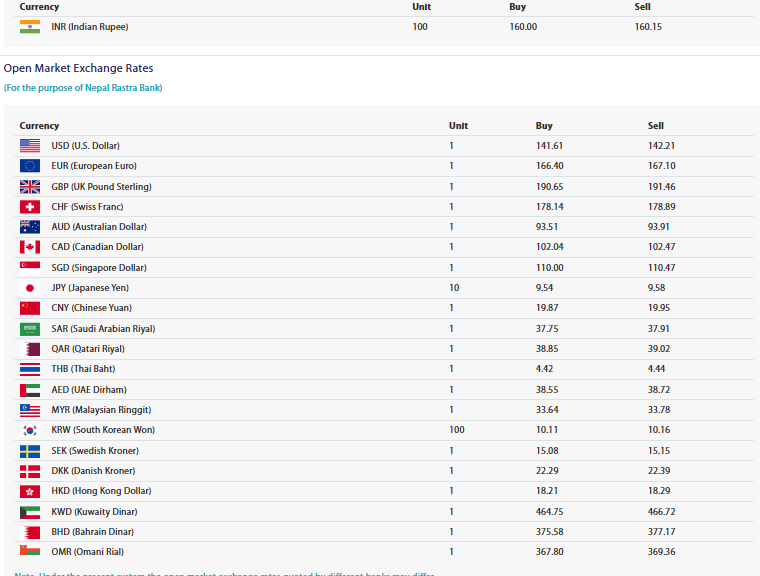
Similarly, the Bahraini dinar stands at Rs. 375.58 (buying) and Rs. 377.17 (selling), while the Omani rial is pegged at Rs. 367.80 (buying) and Rs. 368.36 (selling). These currencies reflect the higher purchasing power of oil-rich Gulf nations.
Indian Rupee Peg Remains Steady
As always, the Indian rupee, Nepal’s closest currency partner, remains fixed under the existing peg arrangement. For today, 100 Indian rupees are valued at Rs. 160.00 (buying) and Rs. 160.15 (selling). This peg has long been a cornerstone of Nepal’s monetary stability, given the volume of trade, remittances, and tourism exchange between the two countries.
Implications for Trade, Tourism, and Remittances
Foreign exchange rates play a crucial role in shaping Nepal’s economic landscape. Traders dealing in imports and exports rely on daily updates to determine transaction costs, while the tourism industry often factors in exchange rates to attract foreign visitors.
A stronger U.S. dollar benefits Nepali workers abroad who send remittances home, increasing the value of money received by families in Nepal. On the other hand, a stronger euro or pound can make Nepal more attractive for European travelers, as their currencies stretch further in Nepali markets.
Role of NRB in Currency Stability
Nepal Rastra Bank regularly monitors global financial markets to set daily reference exchange rates. These rates provide a benchmark for commercial banks, although banks are allowed some flexibility in offering slightly different buy and sell prices.

The central bank has also noted that exchange rates may be revised at any time if market conditions demand. To maintain transparency, updated rates are always available on the NRB’s official website.
Nepal’s currency market remains highly sensitive to fluctuations in global markets, including oil prices, interest rate changes in major economies, and geopolitical developments. By publishing daily exchange rates, NRB helps stabilize expectations and ensures that the Nepali economy, particularly trade and remittance sectors, continues to function smoothly.
Today’s update once again reflects NRB’s role as a stabilizing authority, balancing international trends with domestic needs, while providing accurate information to businesses, banks, and citizens alike.