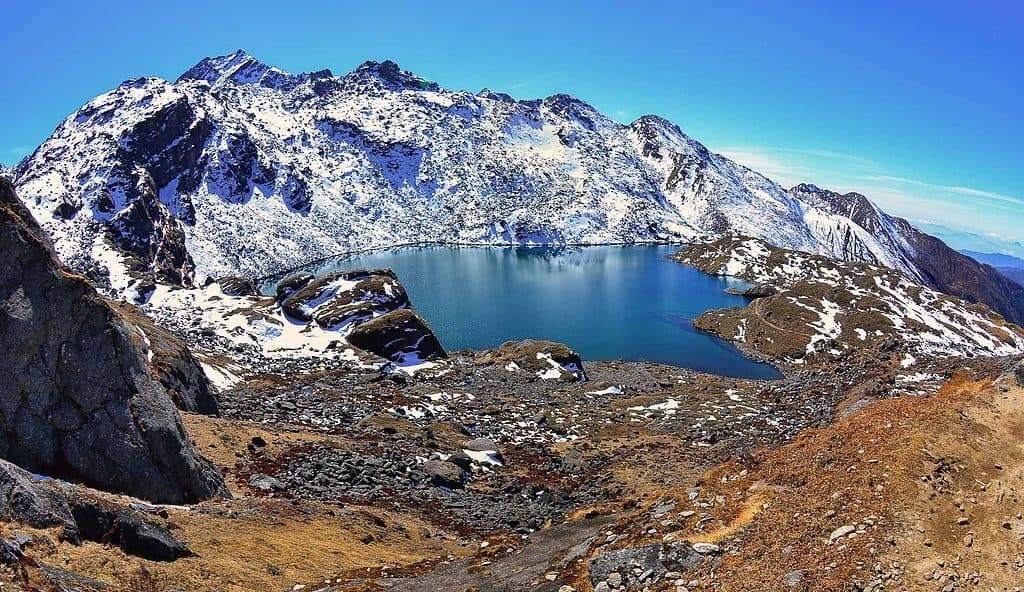
At an altitude of 4,380 meters in the Langtang National Park, Gosainkunda Lake emerges like a sapphire set within the rugged crown of the Himalayas. Surrounded by jagged peaks, rocky cliffs, and vast alpine silence, the lake is not merely a natural wonder but one of Nepal’s most sacred spiritual landscapes.
Here, the air is thin, the wind is sharp, and the environment feels untouched by time. Every step toward Gosainkunda feels like a gradual retreat from the ordinary world and an entry into something elemental and divine. Pilgrims and trekkers alike describe the experience not as travel, but as ascent, both physical and spiritual.
The lake holds deep significance in Hindu mythology, where it is believed to have been created by Lord Shiva himself. According to legend, when Shiva swallowed the deadly poison that threatened to destroy the universe, he struck the ground with his trident to obtain water and cool his burning throat. From this divine act, Gosainkunda was born. The lake is thus considered sacred water formed from cosmic sacrifice, linking it directly to themes of creation, destruction, and renewal.

The Spiritual Power of Water and Myth
Gosainkunda is not a single lake but part of a sacred cluster of alpine lakes, each carrying its own spiritual identity. Among them are Bhairav Kunda, Saraswati Kunda, and several smaller glacial pools that together form a sacred geography of water and devotion.
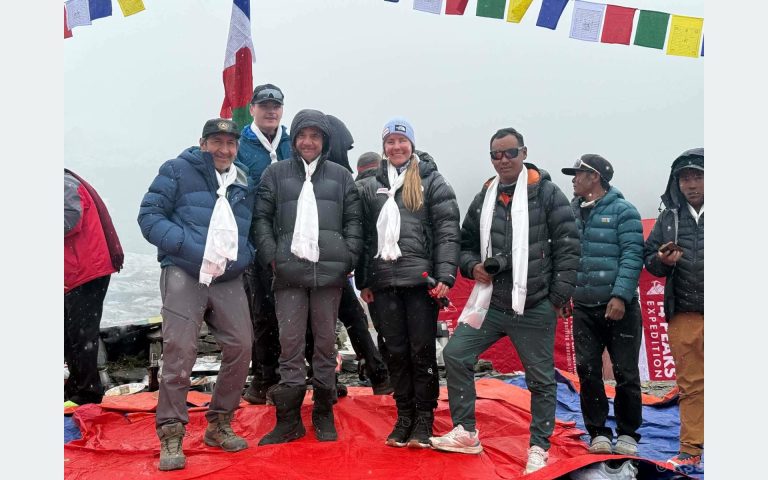
During the full moon festival of Janai Purnima, thousands of Hindu pilgrims make the arduous journey to Gosainkunda. They come from across Nepal and India, walking for days through steep terrain, dense forests, and remote mountain trails. Upon reaching the lake, they immerse themselves in its icy waters, believing it purifies sins accumulated over lifetimes. The act of bathing in Gosainkunda is not symbolic alone, it is deeply emotional and transformative. The freezing water shocks the body, yet devotees willingly embrace it as an offering of surrender. For them, the lake is not a destination but a divine threshold.
A Journey Through Landscapes of Transformation
The trek to Gosainkunda is one of the most demanding yet spiritually rewarding journeys in Nepal. Starting from Dhunche or Sundarijal, travelers ascend gradually through villages inhabited by the Tamang community, whose cultural traditions are deeply connected to Tibetan Buddhism.
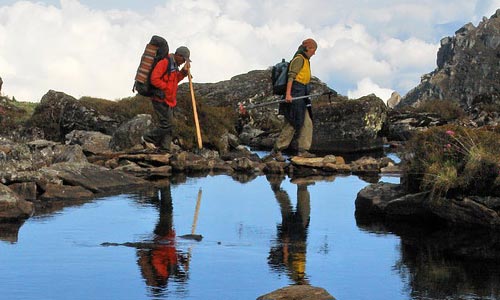
As the trail climbs higher, the environment changes dramatically. Dense forests of oak and rhododendron give way to alpine meadows, and eventually to barren rocky terrain. The sound of rivers fades, replaced by wind and silence. Every stage of the journey feels like a stripping away of worldly noise.
Trekkers often describe a growing sense of introspection. With each step upward, distractions diminish, and awareness deepens. By the time Gosainkunda appears in view, shimmering beneath snow-covered peaks, many feel they are not just arriving at a lake, but at a state of mind.
The Lake That Freezes and Awakens
For nearly half the year, Gosainkunda remains frozen. From late autumn to early spring, the lake transforms into a vast sheet of ice, reflecting the surrounding mountains like a mirror. In summer, it thaws and reveals its deep blue waters, fed by melting glaciers and mountain streams.
This seasonal transformation adds symbolic depth to its spiritual meaning. The lake represents cycles of dormancy and awakening, death and rebirth, core themes in both Hindu and Buddhist philosophy. Even in its frozen state, pilgrims consider it sacred. They do not see it as lifeless but as quietly meditative, holding divine energy beneath its icy surface.
A Meeting Point of Faith and Nature
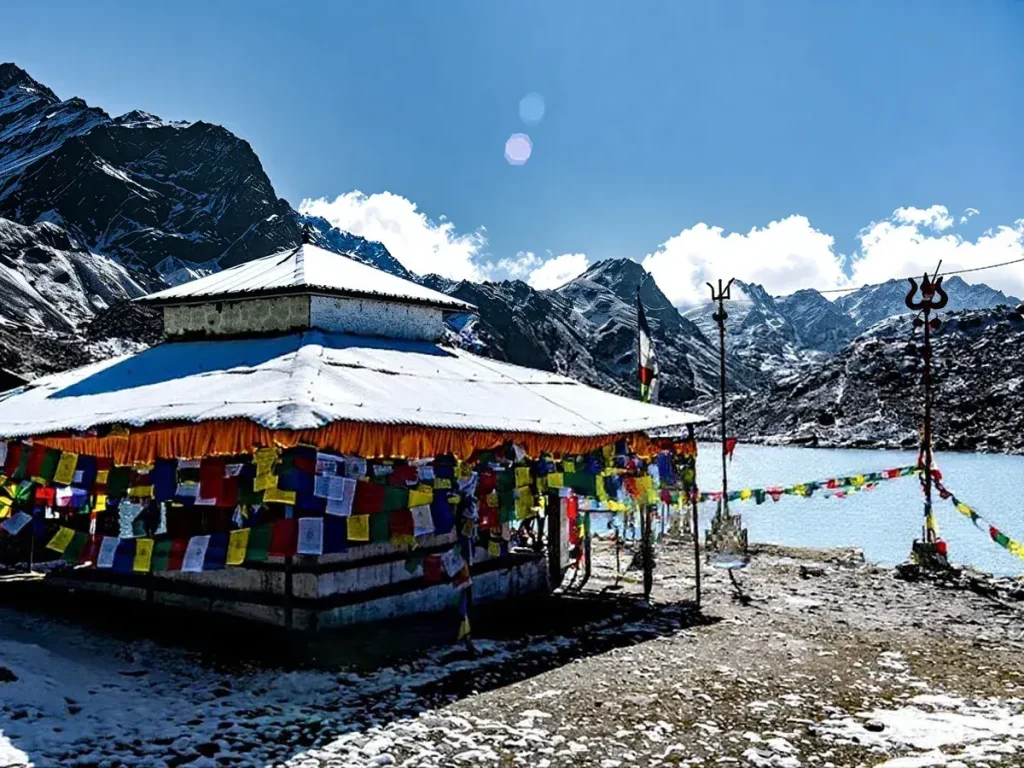
What makes Gosainkunda extraordinary is the way spirituality blends seamlessly with natural grandeur. There are no grand temples or artificial structures here. The lake itself is the shrine. The mountains are its walls. The sky is its ceiling. At sunrise, the peaks glow in shades of gold and pink, reflecting onto the still waters. At night, stars scatter across the sky with unmatched clarity. In such moments, the boundary between earth and cosmos feels almost invisible. For many visitors, Gosainkunda is not just about religious belief but about experiencing a sense of universal connection. It becomes a place where nature itself feels sacred, and silence becomes prayer.
Where Water Becomes Divine Memory
Gosainkunda Lake stands as one of the most powerful symbols of Nepal’s spiritual geography. It teaches that divinity is not distant or abstract but embedded in the natural world itself. Here, in the heart of the Himalayas, water becomes mythology, mountains become guardians, and silence becomes scripture. Whether approached as a pilgrimage or a journey of exploration, Gosainkunda leaves an imprint that is both emotional and spiritual. It is a place where humans do not merely visit nature, they encounter something far greater than themselves.