Mustang, home to the sacred pilgrimage sites of Muktinath and Damodar Kunda, holds immense religious value for both Hindu and Buddhist devotees. It is widely believed that bathing, praying, and receiving blessings at these sites, including Kagbeni, can cleanse sins and grant spiritual merit. However, beyond its religious significance, Mustang also stands as a major tourist destination.
According to the District Police Office’s statistics, 427,000 visitors, including pilgrims, entered Mustang via road during the fiscal year 2080/81. The district’s unique geography, lakes, caves, monasteries, religious sites, apple orchards, and diverse culture continue to captivate tourists.
Despite this, traveling to Mustang remains challenging. The only road connecting Mustang to the national highway is the Beni-Jomsom-Korala section of the Kaligandaki Corridor, which links the Gandaki Province’s “lifeline” from the Indian border at Triveni to the Chinese border at Korala Nakaa.
This road opened in 2063 BS, is expected to play a pivotal role in Gandaki Province’s infrastructure, economic development, hydropower, tourism, and religious sectors. However, delays in upgrading the road, particularly in the Myagdi and Parbat sections, have caused significant hardships for locals, tourists, and pilgrims alike.
The Beni-Jomsom-Korala road project, spanning 202 kilometers, began upgrading in 2073 BS and has achieved 84% physical progress over eight years. The estimated cost of this project is NPR 10 billion, with NPR 6 billion already spent by the end of the last fiscal year. The project aims to asphalt 105 kilometers of road, with 48 kilometers already paved, 5 kilometers concreted, and 85 kilometers graveled, according to project chief Dhrubakumar Jha. Moreover, 24 motorable bridges are required, of which 19 have been contracted, 10 completed, and 5 are under construction. However, 5 bridges remain in the tender process, and three temporary Bailey bridges have been installed to facilitate traffic.
Jha also highlighted several setbacks, such as unauthorized road construction, weak terrain, landslides, and court orders halting stone, gravel, and sand extraction from the Kaligandaki River, all of which have delayed progress.
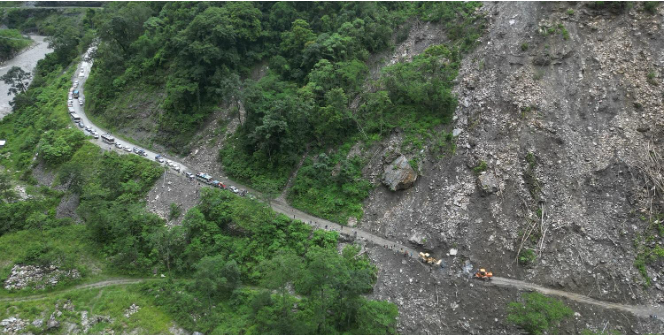
Landslides, floods, and erosion pose significant threats to the Beni-Jomsom-Korala road, particularly in monsoon seasons. The Kaligandaki River and its tributaries frequently erode the road, causing disruptions. In 2080 BS, a flood in the Kagbeni River destroyed a motorable bridge. Such issues raise concerns over the safety of travelers and the long-term sustainability of infrastructure.
Out of the 14 landslide-prone areas identified along the road, major disruptions have occurred in Myagdi’s Raghuganga and Annapurna rural municipalities. Constant landslides in places like Guithe Bhir, Khambhitta, and Lata Khola continue to hinder construction and transportation, requiring constant maintenance and mitigation efforts.
Efforts are underway to address the road’s numerous challenges. For instance, the project office has requested funds and plans to build a 384-meter tunnel in the rocky Bhirkate area of Annapurna Rural Municipality. Additionally, rock anchoring and widening of roads are being conducted in landslide-prone areas like Kabre Bhir. For flood and erosion control, diversion of rivers and reinforcement of vulnerable areas are also being carried out. These efforts aim to ensure that the road remains safe and operational.
Former Vice Chairman of the National Planning Commission, Dr. Min Bahadur Shrestha, emphasized the importance of completing the road’s upgrade and addressing the landslide and erosion challenges. He stressed the need for proper budget management and timely completion of the project to ensure Mustang’s accessibility, not only for religious pilgrims but also for commercial and tourism development.
The Beni-Jomsom-Korala road is a vital infrastructure project for Mustang, providing a crucial link for religious, economic, and tourism growth. However, the region’s fragile geography presents significant challenges that require both short- and long-term solutions. Collaborative efforts from the government, local authorities, and engineers are crucial to fully realizing Mustang’s potential as a top destination in Nepal.