Despite its immense religious, cultural, and tourism potential, the Jaljala region, nestled at the tri-junction of Myagdi, Parbat, and Kaski districts, remains largely neglected and underpromoted. Spread across Parbat’s Jaljala and Modi Rural Municipality, as well as Myagdi’s Annapurna Rural Municipality, It holds deep roots in Hindu mythology, where it is referred to as Hampal, Kalanjar, and Mrigasthali in several ancient scriptures.
Renowned scholar and cultural researcher Prof. Dr. Jagannath Regmi highlights that sacred Hindu texts such as Agni Purana, Garuda Purana, Kurma, Varaha, Skanda, Shiva Maha Purana, Padma, Brihannardiya, Linga, Matsya, Mahabharata, and Shrimad Bhagavatam all reference Kalanjar or Hampal as spiritually powerful sites. Yet, despite these lofty mentions, It remains overlooked due to poor infrastructure, lack of promotion, difficult terrain, absence of written documentation, and its remote location away from major settlements.
Mythical Land of Tapasya and Healing Herbs
According to religious lore, Jaljala was once a site where sages and saints performed deep meditation (tapasya), acquired divine knowledge, and used its rare herbs as Ayurvedic medicine. Hindu scriptures claim that a pilgrimage to this region brings spiritual merit, and that offering pinddaan (ancestral offerings) here ensures liberation of the ancestors.
Locals and researchers also believe that it’s forests were once frequented by ancient rishis, and its caves and hidden temples have religious importance that deserves recognition. However, many of these ancient caves, temples, and shelters are on the brink of disappearing due to lack of conservation efforts.
Locals Struggle to Attract Visitors
Despite the region’s natural and religious wealth, tourism in Jaljala remains scarce. Tika Pun, a local restaurant operator from Lespar, Modi Rural Municipality–4, shared that due to lack of publicity, both tourists and pilgrims rarely visit except during specific religious events or trekking seasons.
“Only a few trekkers and devotees come during the spring and autumn months or when special Mahayagyas are held,” Pun said. “The rest of the time, the area is eerily quiet.”
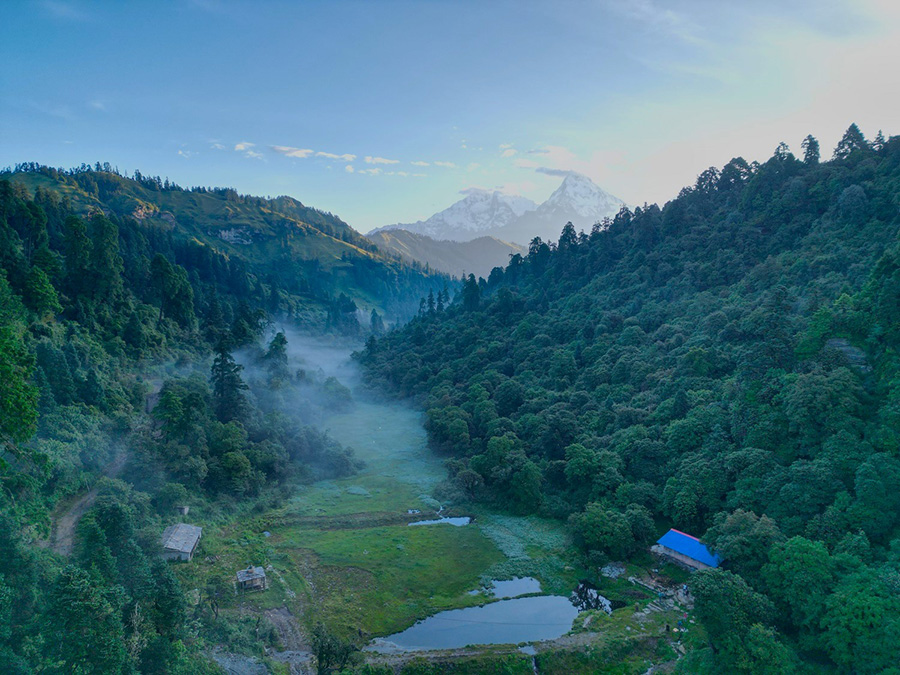
At an elevation of 3,300 meters above sea level, It sits atop a ridge with breathtaking views of the Annapurna Himalaya. The sacred Sim pond rests at its heart, surrounded by dramatic Himalayan landscapes. A short 10-minute hike from Jaljala leads to “Wi-Fi Danda,” a high viewpoint offering panoramic views of Annapurna, while a 30-minute walk reaches Mateko Lekh, from where Dhaulagiri, Machhapuchhre, and other peaks can be observed.
A Treasure Trove of Biodiversity
Jaljala is not only spiritually rich but biologically diverse. The area is home to numerous rare medicinal herbs such as Bojho, Satuwa, Chiraito, Amilo, Brahmi (Bholtapre), Pashanbhed, Jethimadhu, Padamchalnu, Nirameshi, Jatamasi, Timur, and Sil-Timur. Wildlife also thrives in the region. Herds of deer roam its forested slopes, and birds like the Himalayan Monal (Danphe), Kalij, Munal, Chyakhura, vultures, owls, and various woodpeckers can be seen by attentive visitors.
Infrastructure Slowly Expanding
Encouragingly, some infrastructure projects are underway. Jaljala is connected to Ghorepani, Poon Hill, Mohare Danda, and Nagi in Myagdi via trekking routes, and from Parbat’s Modi Rural Municipality via trails and rough roads. Parbat’s Jaljala Rural Municipality has built a dirt road up to Shalija, from where Jaljala is a short trek away.
Deepak Acharya, Vice Chair of Jaljala Rural Municipality, confirmed that electrification has reached the area and that Mahayagyas have been held to highlight its spiritual significance. “The federal government has allocated Rs. 30 million for tourism infrastructure development in Jaljala, and the road from Beni to Lekhphant has recently been blacktopped,” he said. He also noted that proposals to upgrade roads connecting Shalija to Jaljala are already submitted to federal and provincial authorities.
The provincial government has built resting shelters at Wi-Fi Danda and along trails leading from Mateko Lekh to Jaljala. Similarly, the local government has constructed an ashraya sthal (shelter) at Hampal for the convenience of pilgrims and sadhus.
Vision for a Religious Corridor
Raju Prasad Acharya, Chair of Jaljala Rural Municipality, shared an ambitious plan to draw pilgrims traveling to Mustang and Muktinath through Jaljala. The project includes infrastructure development at Bhumesthan in Dhairing, the operation of a gaushala (cow shelter), and the establishment of a religious corridor that connects Jaljala, Phalamdanda, Mallaj, and the Ram Temple.
“Our vision is to integrate Jaljala into existing pilgrimage and trekking networks so that visitors extend their stay and experience more of what this sacred land has to offer,” said Chair Acharya. “By connecting Ghorepani–Mohare Danda–Jaljala–Mate–Modi–Bano–Kushma through an extended trail, we aim to both preserve the route and promote it as a major spiritual and eco-tourism destination.”