Nepal Rastra Bank (NRB), the central bank of Nepal, has released the official foreign exchange rates for Sunday, providing detailed buying and selling rates for a wide range of international currencies. The announcement, issued on Saturday, outlines the exchange rates for the US dollar, European currencies, Asian currencies, and other major global currencies.
US Dollar and Major Western Currencies
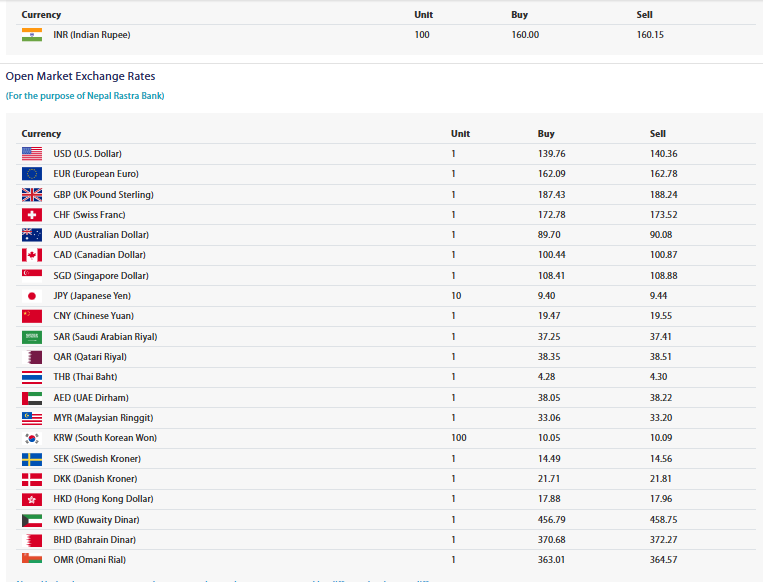
According to NRB, the buying rate for one US dollar has been fixed at NPR 139.76, while the selling rate stands at NPR 140.36. The euro, one of the most widely traded currencies globally, has a buying rate of NPR 162.09 and a selling rate of NPR 162.78. Similarly, the British pound sterling is valued at a buying rate of NPR 187.43 and a selling rate of NPR 188.24.
The Swiss franc, another strong European currency, has been fixed at NPR 172.78 for buying and NPR 173.52 for selling. These rates reflect the ongoing trends in global currency markets, influenced by economic conditions, trade activities, and central bank policies worldwide.
Australian, Canadian, and Singapore Dollars
Among other major international currencies, the Australian dollar’s buying rate is set at NPR 89.70 and the selling rate at NPR 90.08. The Canadian dollar stands at NPR 100.44 for buying and NPR 100.87 for selling. The Singapore dollar, which is often used in regional trade, has been fixed at NPR 108.41 for buying and NPR 108.88 for selling.
These rates are important for businesses engaged in imports and exports, tourism, and international investments, as they directly affect the cost of goods, travel, and financial transactions involving these currencies.
Asian Currencies: Yen, Yuan, and Gulf Currencies
In the Asian currency market, the Japanese yen—quoted per 10 units—has been set at NPR 9.40 for buying and NPR 9.44 for selling. The Chinese yuan is valued at NPR 19.47 for buying and NPR 19.55 for selling.
The Gulf currencies, often used by Nepali migrant workers in remittance transactions, also feature in the official rate list. The Saudi Arabian riyal is fixed at NPR 37.25 for buying and NPR 37.41 for selling, while the Qatari riyal stands at NPR 38.35 for buying and NPR 38.51 for selling. These rates are particularly significant for remittance inflows, as a large number of Nepali workers are employed in Gulf countries.
Other Asian and Regional Currencies
The Thai baht’s buying rate is set at NPR 4.28, with the selling rate at NPR 4.30. The UAE dirham is fixed at NPR 38.05 for buying and NPR 38.22 for selling. The Malaysian ringgit stands at NPR 33.06 for buying and NPR 33.20 for selling.
South Korea’s currency, the won, is quoted per 100 units at NPR 10.05 for buying and NPR 10.09 for selling. Among Scandinavian currencies, the Swedish krona is set at NPR 14.49 for buying and NPR 14.56 for selling, while the Danish krone is valued at NPR 21.71 for buying and NPR 21.81 for selling.
Hong Kong Dollar and High-Value Middle Eastern Currencies
The Hong Kong dollar is fixed at NPR 17.88 for buying and NPR 17.96 for selling. In the high-value currency category, the Kuwaiti dinar tops the list at NPR 456.79 for buying and NPR 458.75 for selling. The Bahraini dinar is valued at NPR 370.68 for buying and NPR 372.27 for selling, while the Omani rial stands at NPR 363.01 for buying and NPR 364.57 for selling. These high-value currencies are closely watched by financial analysts and traders due to their significant role in international trade and investment.
Indian Rupee and Cross-Border Trade
The Indian rupee, which plays a crucial role in Nepal’s cross-border trade and daily transactions in border areas, has been fixed at NPR 160.00 for buying and NPR 160.15 for selling per 100 units. Since Nepal and India share an open border and have deep economic ties, the exchange rate of the Indian rupee is especially important for businesses and individuals engaged in trade, tourism, and remittance activities between the two countries.
Exchange Rate Flexibility and Bank Discretion
Nepal Rastra Bank has clarified that the announced rates can be revised at any time, depending on market conditions and economic developments. The central bank regularly monitors currency movements in both domestic and international markets to ensure exchange rates remain in line with economic fundamentals.
NRB also noted that the rates set by commercial banks may differ from those announced by the central bank, as individual banks have the discretion to adjust their rates based on supply and demand, transaction volumes, and operational costs.
Accessing Updated Exchange Rates
For individuals and businesses seeking the most recent and accurate exchange rates, the central bank has made the information available on its official website. The regularly updated online platform ensures that traders, tourists, and remittance receivers can make informed decisions when converting currencies.
The availability of accurate exchange rate information is particularly important for importers and exporters, travel agencies, money exchange firms, and migrant workers. By providing a reliable reference point, NRB’s daily publication helps reduce uncertainty and supports transparency in currency-related transactions.
Impact on Economy and Public Transactions
Foreign exchange rates have far-reaching impacts on Nepal’s economy. A stronger US dollar, for instance, can make imports more expensive but increase remittance values in local currency. On the other hand, a weaker dollar may reduce the cost of imported goods but lower the income for remittance-dependent households.
Similarly, fluctuations in the euro, pound sterling, or Gulf currencies can affect the purchasing power of Nepalis traveling abroad, studying overseas, or sending money to and from other countries. Businesses engaged in international trade must carefully monitor these rates to maintain competitiveness and profitability.
The foreign exchange rate announcement by Nepal Rastra Bank serves as a key financial guide for the country’s economic activities. By maintaining transparency and updating rates regularly, NRB plays a vital role in stabilizing the foreign currency market, protecting consumers, and supporting Nepal’s economic growth.