The Nepal Rastra Bank (NRB) has published the latest open market exchange rates for various foreign currencies, reflecting the current trends in the international currency market and their influence on Nepal’s economy. These rates are critical for businesses, travelers, and financial institutions involved in foreign trade and remittances. The currency market today shows a relatively stable trend, with minor fluctuations observed in some major currencies.
Indian Rupee Exchange Rates Remain Stable
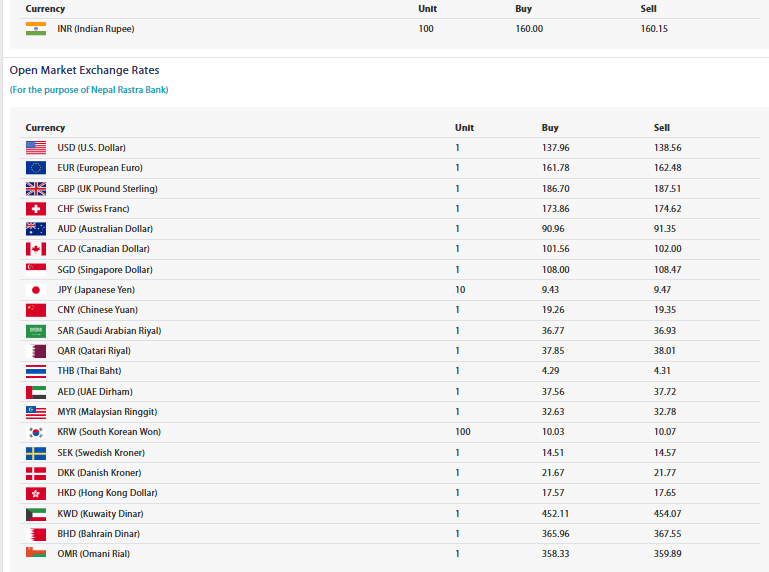
The Indian Rupee (INR), which is Nepal’s closest trading partner’s currency and widely used in cross-border trade and transactions, remains relatively stable. According to the NRB, the buying rate for 100 Indian Rupees stands at NPR 160.00, while the selling rate is NPR 160.15. The slight difference between buying and selling rates indicates a narrow spread, reflecting steady demand and supply in the open market.
Given the deep economic and cultural ties between Nepal and India, these rates play a significant role in everyday commerce and remittance flows. Traders and consumers closely monitor INR rates as any significant changes can influence prices of imported goods and the overall inflation rate in Nepal.
U.S. Dollar Continues to Dominate Foreign Exchange Market
The U.S. Dollar (USD), the most widely used global currency and a standard in international trade, is quoted at a buying rate of NPR 137.96 and a selling rate of NPR 138.56. This marginal spread indicates that the USD remains in steady demand in Nepal’s foreign exchange market.
The USD’s strength and rate movement are crucial for Nepal, particularly for sectors like tourism, import-export businesses, and remittance recipients. Since a significant portion of Nepal’s remittance inflows are denominated in USD, fluctuations in its rate directly impact the income of many households across the country.
European Euro and British Pound Sterling Show Moderate Variations
The European Euro (EUR) has seen its buying rate fixed at NPR 161.78 and the selling rate at NPR 162.48. Meanwhile, the British Pound Sterling (GBP), a key currency in international finance, is priced at NPR 186.70 for buying and NPR 187.51 for selling.
These currencies, often used in international trade and travel, exhibit moderate variations indicating balanced trading activities. Businesses involved in importing European and British goods or engaging in services with these regions closely watch these rates to time their transactions advantageously.
Other Major Currencies Reflect Market Trends
Several other currencies have been listed by NRB with respective buying and selling rates indicating current market trends:
- The Swiss Franc (CHF) is being bought at NPR 173.86 and sold at NPR 174.62.
- The Australian Dollar (AUD) is priced at NPR 90.96 for buying and NPR 91.35 for selling.
- The Canadian Dollar (CAD) shows buying at NPR 101.56 and selling at NPR 102.00.
- The Singapore Dollar (SGD) is available at NPR 108.00 (buying) and NPR 108.47 (selling).
- The Japanese Yen (JPY) is priced per 10 units at NPR 9.43 for buying and NPR 9.47 for selling.
These currencies reflect active trading ties with their respective countries and their influence on Nepal’s trade balance and foreign exchange reserves.
Middle Eastern Currencies Remain in Demand
Currencies from the Middle East, vital due to the large number of Nepalese working in Gulf countries, also show stable rates:
- Saudi Arabian Riyal (SAR) buying rate stands at NPR 36.77 and selling at NPR 36.93.
- Qatari Riyal (QAR) is bought at NPR 37.85 and sold at NPR 38.01.
- UAE Dirham (AED) is quoted at NPR 37.56 for buying and NPR 37.72 for selling.
- Kuwaiti Dinar (KWD) commands a higher exchange rate with buying at NPR 365.96 and selling at NPR 367.55.
- Bahrain Dinar (BHD) is at NPR 358.33 for buying and NPR 359.89 for selling.
The stability in these currencies is vital for Nepal’s economy, given the significant remittance inflows from workers in these countries, which bolster the country’s foreign currency reserves and support the local economy.
Asian and Other International Currencies Reflect Global Market Dynamics
Additional currencies such as the Chinese Yuan (CNY), Malaysian Ringgit (MYR), South Korean Won (KRW), and others also feature in the exchange rates, showing Nepal’s diverse economic ties across Asia:
- The Chinese Yuan (CNY) is bought at NPR 19.26 and sold at NPR 19.35.
- Malaysian Ringgit (MYR) holds rates of NPR 32.78 for buying.
- South Korean Won (KRW) is quoted per 100 units at NPR 10.03 for buying and NPR 10.07 for selling.
Other currencies such as the Thai Baht (THB), Swedish Kroner (SEK), Danish Kroner (DKK), and Hong Kong Dollar (HKD) also see minor fluctuations in their rates, reflecting the global economic trends and currency valuations.
Impact on Nepal’s Economy and Stakeholders
The current exchange rates released by the Nepal Rastra Bank provide essential signals to various stakeholders in Nepal’s economy. Importers and exporters use these rates to calculate costs and price competitiveness in international markets. Remittance recipients depend on favorable exchange rates to maximize the local currency value of funds sent by relatives abroad. Tourists and travelers also find these rates important for budgeting and currency conversion during their trips.
The relatively stable currency rates reflect a balanced supply and demand environment and may be indicative of the overall economic stability in Nepal amidst global uncertainties. However, continuous monitoring is necessary as global political and economic changes, including interest rate adjustments by central banks worldwide, trade negotiations, and geopolitical tensions, could quickly influence these rates.
The Nepal Rastra Bank’s latest currency exchange rates present a comprehensive overview of Nepal’s foreign currency market, highlighting the importance of stable and transparent currency trading for economic prosperity. Stakeholders across sectors must remain vigilant to the fluctuations to manage risks and seize opportunities arising from currency movements.
As Nepal continues to strengthen its economic ties globally, these exchange rates serve as an important barometer for economic health, trade balance, and financial planning.