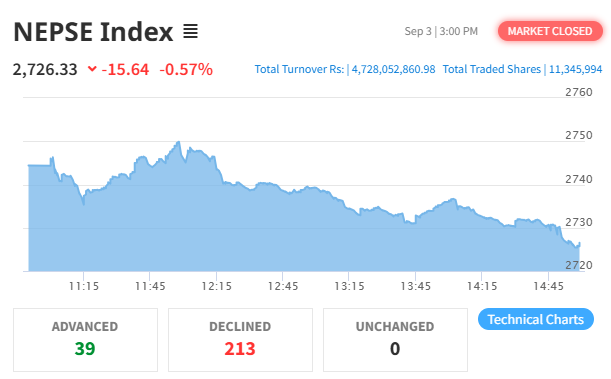
The Nepal Stock Exchange (NEPSE) Index recorded a decline in today’s trading session, shedding 15.64 points, or 0.57%, to close at 2,726.33. This marks a continuation of the bearish trend, following a 19.89-point loss in the previous session, reflecting cautious investor sentiment amid ongoing market fluctuations.
Market Movement and Intraday Performance
The benchmark index opened the day at 2,744.41, reaching an intraday high of 2,749.88 before slipping to the day’s lowest point of 2,724.99. Despite moments of optimism during the session, overall market activity remained subdued, with investors adopting a wait-and-see approach. Total turnover for the day amounted to Rs. 4.72 Arba, with 11,345,994 shares traded across 326 listed companies through 68,594 transactions. The market capitalization stood at Rs. 45.57 Kharba, while the float market capitalization was recorded at Rs. 15.45 Kharba, indicating a moderate level of liquidity in the market.
Sectoral Performance Highlights
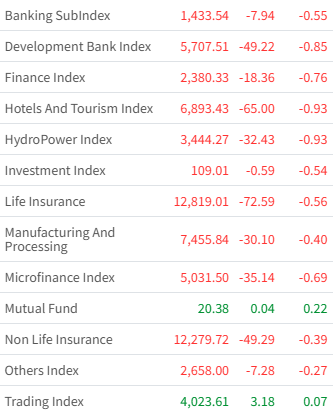
Among sectoral indices, the Hotels and Tourism Index bore the brunt of today’s losses, shedding 65.00 points, or 0.93%, to settle at 6,893.43. This represents a sharper decline compared to the previous session’s loss of 36.74 points, highlighting ongoing pressure on the tourism-related stocks amid subdued business and investor sentiment. The sector opened at 6,958.44, touched an intraday high of 6,990.53, and fell to a low of 6,885.89, reflecting the volatility within the hospitality and tourism sector.
Conversely, the Trading Index recorded the highest gain among the sectors, posting a modest increase of 0.07%. While this gain was marginal, it demonstrates selective investor interest in trading-related stocks, even as broader market conditions remain cautious. Other sectoral indices showed mixed performance, with some sectors experiencing minor gains while others continued to struggle due to market uncertainty and profit-taking activities.
Investor Sentiment and Market Outlook
The consecutive losses at NEPSE have signaled a cautious mood among investors, who appear hesitant to make large-scale investments amid fluctuating market conditions. Analysts suggest that short-term profit-taking, combined with global market uncertainties, may have contributed to the downward pressure on the benchmark index. Investors are reportedly keeping a close eye on corporate performance reports, macroeconomic developments, and regional market trends before committing significant capital.
Despite the decline, trading volumes suggest that there is still active participation in the market. A total of 11.3 million shares changed hands during the session, reflecting steady engagement from institutional and retail investors. Market experts note that such volumes indicate underlying interest in select stocks, even amid broader sectoral weaknesses, especially in hospitality and tourism, which continue to face challenges from external economic pressures and seasonal business fluctuations.
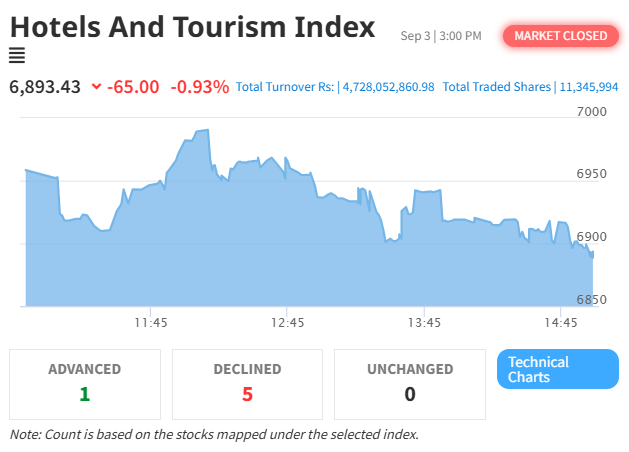
Sectoral Focus: Hotels and Tourism Under Pressure
The Hotels and Tourism Index’s significant loss today underscores the vulnerability of the sector. Investors remain cautious due to ongoing concerns about profitability and demand uncertainties, which have historically influenced performance in tourism-related businesses. Analysts suggest that while the sector has potential for recovery, immediate investor interest may remain subdued until clearer economic indicators and sector-specific growth signals emerge.
On the other hand, the modest gains in the Trading Index indicate that some segments of the market continue to attract interest, reflecting investors’ targeted strategies to balance risk and return. The market’s overall mixed performance demonstrates that while the broader index has seen declines, pockets of opportunity remain, particularly in sectors resilient to short-term volatility.
Navigating Market Volatility
NEPSE’s performance today reflects a continuation of the cautious sentiment observed in the previous session. The benchmark index’s 15.64-point decline, combined with sectoral losses, particularly in the Hotels and Tourism Index, illustrates the challenges faced by investors navigating market volatility. While selective gains in the Trading Index offer some optimism, market participants remain attentive to macroeconomic signals and sector-specific developments.
Analysts suggest that prudent investment strategies, diversification, and close monitoring of market trends will be essential for investors aiming to navigate Nepal’s stock market in the near term. Despite the current downturn, the market retains potential for recovery, provided positive corporate performance, policy measures, and investor confidence contribute to stabilizing trading sentiment.