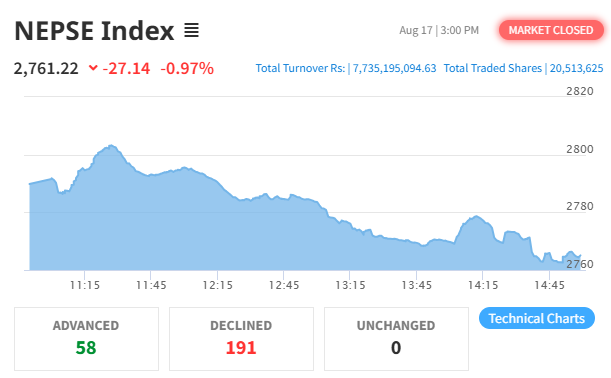
The Nepal Stock Exchange (NEPSE) witnessed a downturn today, as the benchmark index lost 27.14 points, or 0.97%, closing at 2,761.22. This comes on the heels of a modest 2.62-point gain recorded in the previous session, signaling renewed volatility in the market.
Market analysts suggest that the decline reflects cautious investor sentiment amid mixed performances across various sectors. Traders observed a cautious start to the session, with the index opening at 2,789.85 and peaking at an intraday high of 2,803.25 before gradually succumbing to downward pressure. The day’s lowest point was recorded at 2,761.22, indicating a session dominated by profit-taking and selective selling.
Trading Volume and Turnover
Today’s session saw a total turnover of Rs. 7.73 Arba, with 20,513,625 shares traded. The activity spanned 317 companies, conducted through 86,669 transactions. These figures highlight a robust trading volume despite the overall negative movement in the benchmark index, suggesting active engagement from both retail and institutional investors.
The market capitalization stood at Rs. 46.10 Kharba, while the float market capitalization, a measure of shares available for trading, was recorded at Rs. 15.61 Kharba. Analysts note that while overall market capitalization remains strong, investors are increasingly selective in choosing stocks with better growth prospects.
Sector Performance: Hotel & Tourism Index
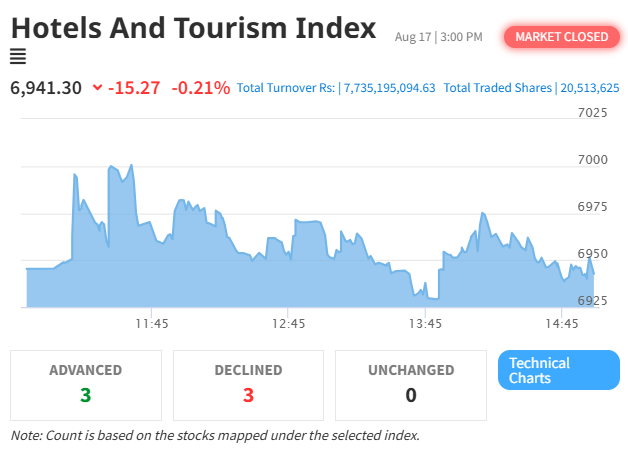
The Hotel & Tourism index also recorded a downturn, losing 15.27 points or 0.21% to close at 6,941.30. This comes after a loss of 7.28 points in the previous session, signaling continued pressure in the sector.
The sector index opened at 6,945.33 and touched an intraday high of 7,000.58 before sliding to a low of 6,929.12. Market observers attribute the decline to fluctuating investor confidence in tourism-related stocks, as seasonal variations and operational costs continue to influence performance.
Tourism remains a critical component of Nepal’s economy, and fluctuations in this sector index often reflect broader investor sentiment towards hospitality and travel companies. Analysts note that while some stocks within the sector showed resilience, profit-taking in highly traded shares contributed to the overall slide.
Investor Sentiment and Market Dynamics
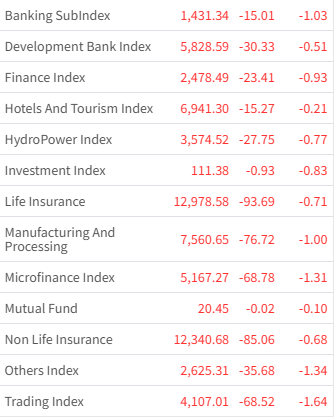
The NEPSE’s decline today underscores a period of cautious optimism among investors. While the market has shown growth in certain sessions, intermittent profit-booking, coupled with sector-specific concerns, has influenced trading behavior.
Financial experts point out that external factors, including global economic trends, inflationary pressures, and domestic policy shifts, are impacting investor sentiment. “The market is reflecting cautious behavior; investors are balancing short-term gains with long-term prospects,” said a leading market analyst.
Despite the downturn, trading activity remains high, indicating that investors continue to seek opportunities across different sectors. The high number of transactions and traded shares suggests that liquidity remains robust, which is a positive indicator for market stability.
Outlook for the Coming Sessions
Market analysts forecast a cautious outlook for the coming sessions, with potential volatility continuing. The performance of key sectors, particularly tourism and banking, will likely influence the direction of the NEPSE index.
Investors are encouraged to monitor both macroeconomic indicators and company-specific fundamentals, as these factors are expected to guide market sentiment in the near term. As global and domestic conditions evolve, the NEPSE is likely to witness periods of both growth and consolidation.
Today’s trading session at the Nepal Stock Exchange reflects a cautious market environment, marked by selective selling and sector-specific pressures. While the NEPSE index experienced a loss of 27.14 points, trading volume remained strong, underscoring continued investor engagement.
The Hotel & Tourism sector, a vital contributor to Nepal’s economy, also faced a decline, highlighting ongoing challenges amid market fluctuations. Investors are advised to exercise prudence while seeking opportunities in resilient stocks.
With volatility expected to persist, market participants will be closely watching developments in key sectors and economic policies to guide their investment decisions. Overall, while today’s losses reflect short-term pressure, the underlying liquidity and investor activity indicate that Nepal’s capital market continues to offer avenues for strategic investment.