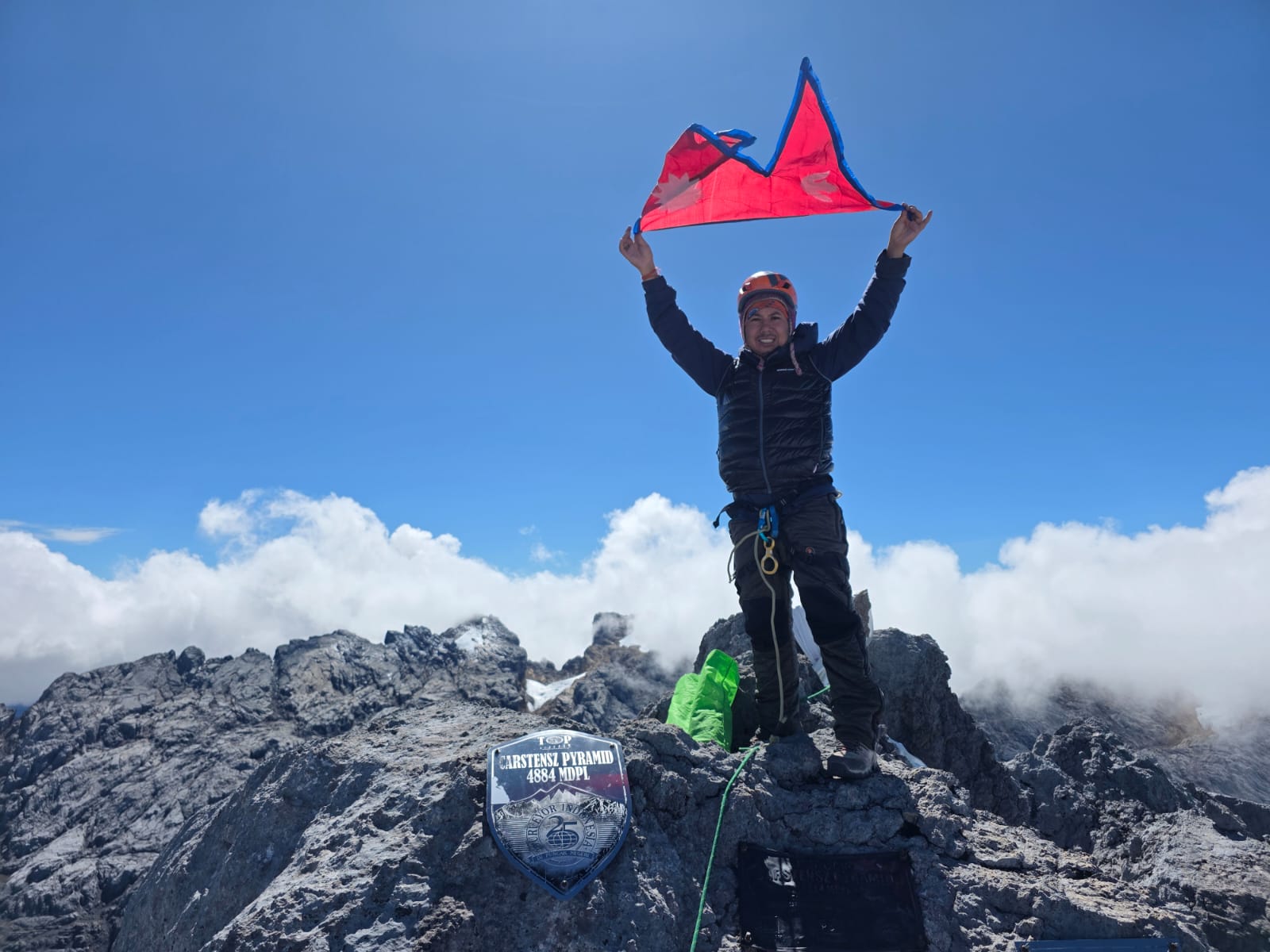
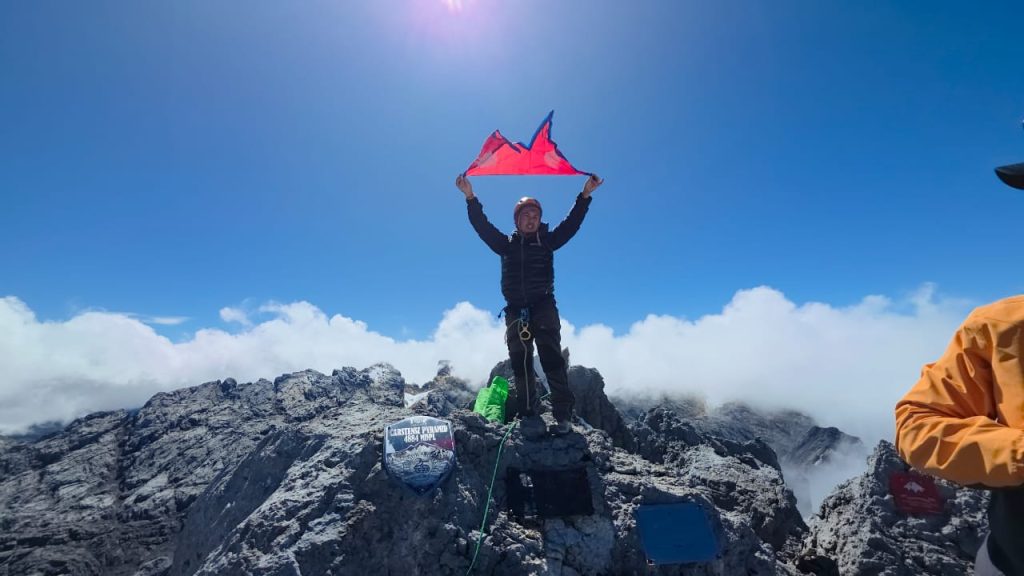
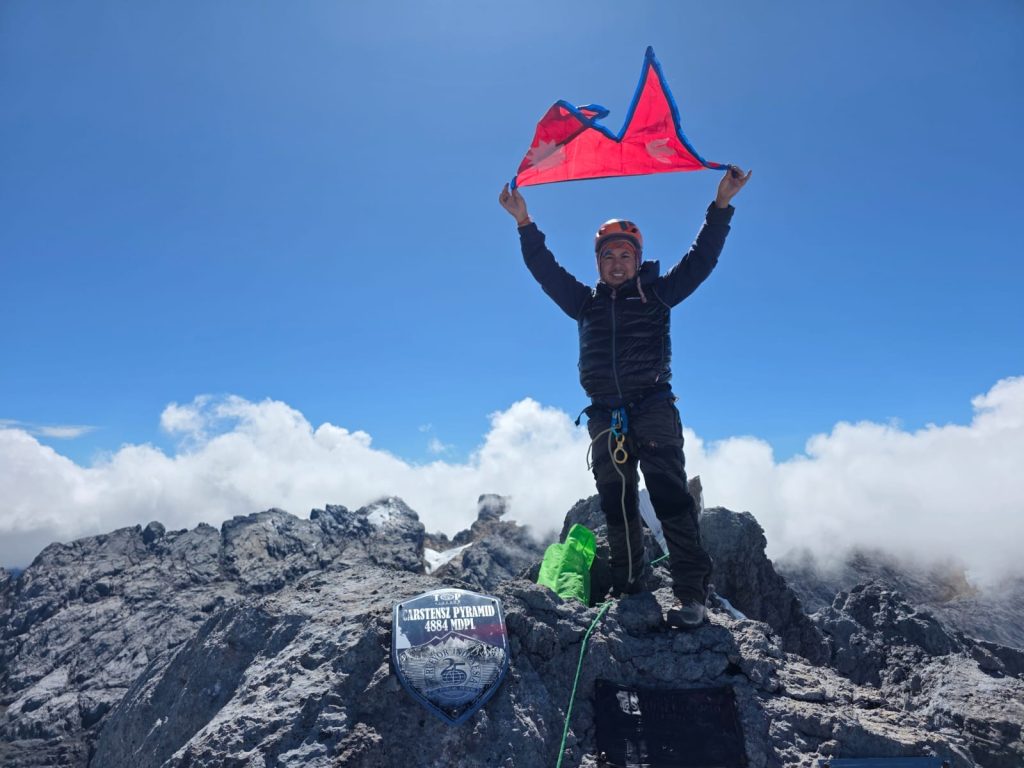
Nepali mountaineer Prakash Raj Pandey has successfully scaled Carstensz Pyramid (Puncak Jaya), the highest peak in Oceania, located in Indonesia’s Papua Province. On the morning of August 17, at around 9:30 local time, Pandey proudly hoisted the Nepali national flag bearing the sun and moon emblem on the summit. This historic climb marks his fifth successful ascent in the ongoing Seven Summits Challenge, the ambitious mission of conquering the tallest mountains on all seven continents.
Pandey had departed Nepal for Indonesia on August 11, carrying the national flag handed to him by Prime Minister K.P. Sharma Oli. His achievement is another step forward in his determined pursuit to showcase Nepal’s mountaineering legacy across the globe.
A Seasoned Climber’s Journey
Pandey is no stranger to challenging climbs. An experienced mountaineer, he first scaled the world’s tallest peak, Mount Everest, in 2018. Since then, he has continued his mission with determination and discipline. His earlier achievements in the Seven Summits campaign include Mount Elbrus in Europe, Mount Kilimanjaro in Africa (November 2024), and Aconcagua in South America (February 2025). With Carstensz Pyramid now added to the list, Pandey has successfully conquered five of the seven peaks. Speaking after his latest climb, Pandey shared that Carstensz Pyramid tested his endurance and technical ability like no other mountain.
One of the Toughest Challenges
Located at an elevation of 4,884 meters (16,024 ft), Carstensz Pyramid is widely regarded as one of the most technically demanding peaks in the Seven Summits. Unlike snow-draped giants such as Everest or Denali, Carstensz Pyramid is primarily a massive limestone rock formation requiring rope-based climbing for nearly the entire route.
Pandey emphasized this challenge, stating, “The structure of this mountain demands rope-based climbing for most of the route, almost like rock climbing. It constantly tests a climber’s balance and technical skills.” Despite the difficulty, he described the moment of planting Nepal’s national flag on the summit as one filled with immense pride and patriotism.
Flying the Flags of Nepal, Scouts, and Rotary
In addition to Nepal’s iconic triangular flag, Pandey also raised the flags of Nepal Scouts and Rotary International, organizations in which he remains an active and dedicated member. For Pandey, mountaineering is not just about personal achievement, but also about representing institutions and values that inspire service, leadership, and resilience.
International Team Spirit and Indonesia’s Independence Day
Pandey’s successful climb was achieved alongside a multinational team consisting of two Americans, one Polish climber, and two Indonesian climbers, forming a total of six members. The timing of the expedition added a layer of significance, as the summit was reached on Indonesia’s 80th Independence Day.
According to Pandey, the Indonesian climbers celebrated this national milestone with special joy on the mountain top, making the achievement even more meaningful. “This moment was not just about climbing but also about unity, celebration, and respect for each other’s countries,” Pandey said from Timika, the nearest town to Carstensz Pyramid.
Raising Awareness on Climate Change
Beyond mountaineering triumphs, Pandey continues to dedicate his expeditions to raising awareness on climate change and environmental sustainability. During his time in Papua, he engaged with local communities and fellow climbers to discuss rising temperatures, erratic rainfall, and the environmental imbalance increasingly visible in the equatorial region.
He also drew parallels with Nepal’s own struggles with glacial melting, unpredictable monsoons, and landslides, stressing the urgency of global cooperation. “Mountains are more than just climbing destinations. They are natural barometers of our planet’s health,” Pandey noted, urging greater commitment to conservation efforts.
Strengthening Nepal-Indonesia Relations
Pandey highlighted the symbolic significance of reaching the Carstensz Pyramid summit on Indonesia’s Independence Day, describing it as a gesture that could foster stronger ties between Nepal and Indonesia. He recalled the historic Bandung Conference, held in Indonesia in 1955, which laid the foundation for the Non-Aligned Movement, a reminder of how shared struggles and triumphs can unite nations.
“This climb can bring the people of Nepal and Indonesia closer, encouraging mutual visits and promoting tourism in both countries,” he said. By carrying Nepal’s flag to foreign summits, Pandey believes he is not only representing his country but also building bridges of friendship and cultural exchange.
The Road Ahead: Three More Summits to Go
With Carstensz Pyramid now behind him, Pandey has three more peaks left to complete his Seven Summits quest: Denali (North America), Vinson Massif (Antarctica), and Mount Kosciuszko (Australia). Each poses its own set of challenges, from Denali’s extreme cold and unpredictable weather to the remoteness of Vinson Massif in Antarctica.
Despite the demanding journey ahead, Pandey remains undeterred. He has expressed his heartfelt dream to conclude this ambitious campaign where it all began, on Mount Everest’s summit, symbolically bringing his global mountaineering mission full circle.
A Symbol of Nepali Pride
Pandey’s latest success is not only a personal milestone but also a source of inspiration for Nepali climbers and youth who aspire to follow in his footsteps. By scaling peaks across continents, he continues to highlight Nepal’s mountaineering spirit while spreading awareness about pressing global issues such as climate change.
As he stood atop the Carstensz Pyramid, holding high Nepal’s flag along with those of his organizations, Pandey carried with him the pride of a nation known for its connection with the mountains. His achievement has once again proven that Nepal’s mountaineering legacy extends far beyond the Himalayas and into every corner of the world.