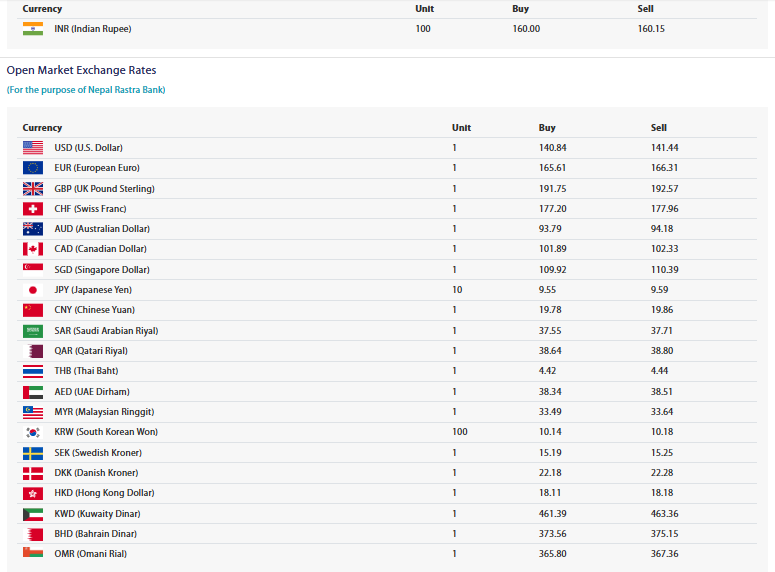
Nepal Rastra Bank (NRB), the central monetary authority of the country, has announced the official foreign exchange rates for today. According to the central bank, the U.S. dollar will be traded at NPR 140.84 for buying and NPR 141.44 for selling. These rates, determined by the central bank, serve as the benchmark for commercial banks and financial institutions in Nepal, though minor variations may occur depending on individual banks.

Major International Currencies
The euro, one of the most widely traded currencies globally, has been fixed at NPR 165.61 for buying and NPR 166.31 for selling. Similarly, the British pound sterling stands at NPR 191.75 for buying and NPR 192.57 for selling. The Swiss franc has been set at NPR 177.20 for buying and NPR 177.96 for selling. These figures reflect the relative strength of major European currencies against the Nepali rupee and provide a key indicator for importers, exporters, and individuals engaged in overseas transactions.
Dollar-Linked Currencies
In addition to the U.S. dollar, other dollar-denominated currencies have also been specified. The Australian dollar is priced at NPR 93.79 for buying and NPR 94.18 for selling. The Canadian dollar stands at NPR 101.89 for buying and NPR 102.33 for selling. Similarly, the Singapore dollar is pegged at NPR 109.92 for buying and NPR 110.39 for selling. These rates highlight the fluctuations in Asia-Pacific dollar-linked economies and their impact on Nepali trade and remittance flows.
Asian Currencies
The Japanese yen has been fixed at NPR 9.55 for buying and NPR 9.59 for selling per 10 units. The Chinese yuan, an increasingly significant currency due to Nepal’s trade relations with China, has been set at NPR 19.78 for buying and NPR 19.86 for selling. Among the Gulf currencies, the Saudi Arabian riyal is priced at NPR 37.55 for buying and NPR 37.71 for selling, while the Qatari riyal stands at NPR 38.64 for buying and NPR 38.80 for selling. These figures are particularly important for Nepali migrant workers and their families, as remittances from Gulf nations form a large part of Nepal’s economy.
Additional Regional Currencies
According to the central bank, the Thai baht is valued at NPR 4.42 for buying and NPR 4.44 for selling. The UAE dirham stands at NPR 38.34 for buying and NPR 38.51 for selling. Likewise, the Malaysian ringgit has been fixed at NPR 33.49 for buying and NPR 33.64 for selling. The South Korean won is priced at NPR 10.14 for buying and NPR 10.18 for selling per 100 units.
In Europe, the Swedish krona is set at NPR 15.19 for buying and NPR 15.25 for selling, while the Danish krone is pegged at NPR 22.18 for buying and NPR 22.28 for selling. These updates reflect the growing diversity of currencies that NRB monitors, given the rise in international trade and mobility of Nepali citizens worldwide.
High-Value Currencies
The Hong Kong dollar is valued at NPR 18.11 for buying and NPR 18.18 for selling. Among the strongest global currencies, the Kuwaiti dinar has been fixed at NPR 461.39 for buying and NPR 463.36 for selling. The Bahraini dinar is set at NPR 373.56 for buying and NPR 375.15 for selling, while the Omani riyal stands at NPR 365.80 for buying and NPR 367.36 for selling. These currencies hold immense importance for Nepalis working in Gulf and Middle Eastern nations, as their earnings and remittances are directly tied to these exchange rates.
Indian Rupee Exchange Rate
The Indian rupee, Nepal’s closest and most relevant foreign currency due to trade and open border relations, has been fixed at NPR 160.00 for buying and NPR 160.15 for selling per 100 Indian rupees. This exchange rate is crucial not only for trade between Nepal and India but also for the millions of Nepalis who travel, work, and study across the border.
NRB’s Role and Flexibility in Rates
The central bank has emphasized that these exchange rates are subject to revision as per necessity. Nepal Rastra Bank retains the authority to adjust the rates in response to global currency movements and domestic economic priorities. While NRB sets the official rates, commercial banks may publish slightly different rates based on demand, supply, and operational considerations.
Furthermore, the central bank has clarified that updated exchange rates are made available daily on its official website, ensuring transparency and accessibility for individuals and institutions engaged in foreign currency transactions.
Implications for Nepal’s Economy
Foreign exchange rates play a vital role in shaping Nepal’s trade balance, remittance inflows, tourism revenue, and inflationary pressures. For importers and exporters, these rates directly affect the cost of goods and services, while for migrant workers, they determine the value of hard-earned remittances sent home.
With Nepal’s heavy reliance on remittances, accounting for nearly a quarter of the national GDP, fluctuations in Gulf, European, and Asian currencies have a significant impact on household income and national reserves. Similarly, the value of the U.S. dollar remains a critical benchmark for Nepal’s international trade and debt servicing obligations.
Nepal Rastra Bank’s announcement of today’s foreign exchange rates underscores the central bank’s ongoing role in stabilizing the economy and guiding financial institutions. With the U.S. dollar set at NPR 140.84 buying and NPR 141.44 selling, and other major currencies adjusted accordingly, individuals and businesses alike are encouraged to stay informed about daily fluctuations.

As global markets continue to experience volatility, NRB’s ability to regulate and update rates remains a crucial element in maintaining economic stability and ensuring fair transactions for all stakeholders in Nepal’s financial system.