Nepal Rastra Bank (NRB), the central bank of Nepal, has announced the official foreign exchange rates for today. The move comes as part of its routine monitoring and regulation of currency transactions in the domestic market. According to the NRB, the US Dollar (USD) has been fixed at a buying rate of NPR 140.95 and a selling rate of NPR 141.55.
These rates are applicable to banks, financial institutions, and authorized money changers across the country and serve as a benchmark for all foreign exchange transactions in Nepal.
European and UK Currencies
The Euro (EUR) has been set at a buying rate of NPR 165.39 and a selling rate of NPR 166.09. The British Pound Sterling (GBP) is valued at NPR 191.10 for buying and NPR 191.91 for selling. Similarly, the Swiss Franc (CHF) has a buying rate of NPR 176.93 and a selling rate of NPR 177.68. The central bank’s rates reflect the current global foreign exchange market trends and are designed to provide stability in cross-border trade and investment activities.
Australian, Canadian, and Singapore Dollars
The Australian Dollar (AUD) is currently fixed at NPR 93.73 for buying and NPR 94.13 for selling. The Canadian Dollar (CAD) is set at NPR 101.83 for buying and NPR 102.26 for selling. Meanwhile, the Singapore Dollar (SGD) has a buying rate of NPR 109.89 and a selling rate of NPR 110.36.
These rates are particularly relevant for tourists, exporters, importers, and Nepalese citizens traveling abroad. Maintaining a consistent exchange rate helps to facilitate trade and financial planning.
Asian Currencies
Among other Asian currencies, the Japanese Yen (JPY), for every 10 units, is fixed at NPR 9.54 for buying and NPR 9.59 for selling. The Chinese Yuan (CNY) is valued at NPR 19.78 for buying and NPR 19.87 for selling. For Middle Eastern currencies, the Saudi Riyal (SAR) has a buying rate of NPR 37.57 and a selling rate of NPR 37.73, while the Qatari Riyal (QAR) is at NPR 38.56 for buying and NPR 38.73 for selling. These rates reflect the growing importance of Asian and Middle Eastern trade partners for Nepal and the increased flow of remittances from these regions.
Thai Baht, UAE Dirham, and Malaysian Ringgit
The Thai Baht (THB) is set at a buying rate of NPR 4.44 and a selling rate of NPR 4.46, while the UAE Dirham (AED) stands at NPR 38.37 for buying and NPR 38.54 for selling. The Malaysian Ringgit (MYR) has been fixed at NPR 33.52 for buying and NPR 33.66 for selling.
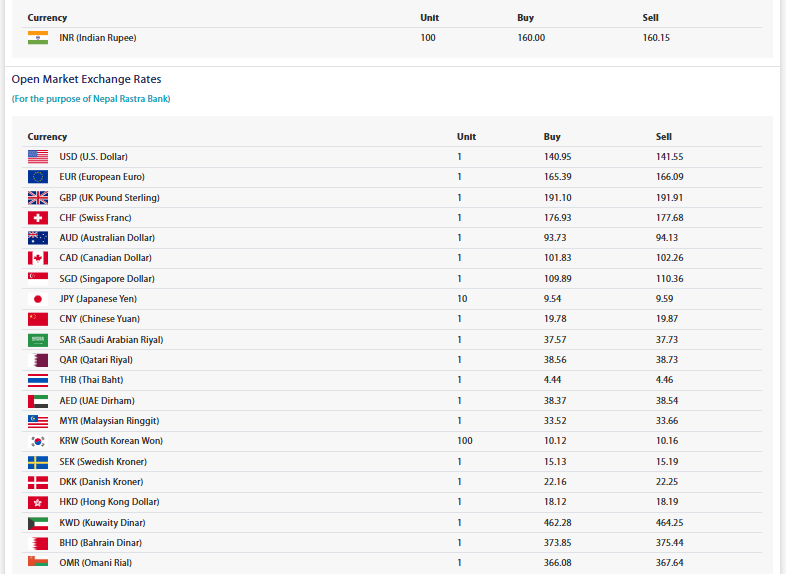
Additionally, the South Korean Won (KRW) for 100 units is valued at NPR 10.12 for buying and NPR 10.16 for selling. The Swedish Krona (SEK) and Danish Krona (DKK) are set at buying/selling rates of NPR 15.13/15.19 and NPR 22.16/22.25, respectively.
Hong Kong Dollar and Middle Eastern Dinars
The Hong Kong Dollar (HKD) is fixed at NPR 18.12 for buying and NPR 18.19 for selling. Meanwhile, the Kuwaiti Dinar (KWD) is valued at NPR 462.28 for buying and NPR 464.25 for selling, and the Bahraini Dinar (BHD) stands at NPR 373.85/375.44. The Omani Rial (OMR) has a buying rate of NPR 366.08 and a selling rate of NPR 367.64. The Indian Rupee (INR), which maintains close bilateral trade links with Nepal, is set at NPR 160.00 for buying and NPR 160.15 for selling for 100 units.
Central Bank’s Authority to Revise Rates
Nepal Rastra Bank has clarified that these rates are indicative and can be revised at any time based on market conditions. Commercial banks may offer slightly different rates depending on their operational requirements and transaction volumes.
The central bank also ensures transparency by publishing updated foreign exchange rates on its official website, allowing the general public, traders, and financial institutions to access the latest information in real time.
Importance for Trade and Remittance
The exchange rates set by NRB are critical for Nepal’s economy, influencing import-export pricing, remittance flows, and foreign investment decisions. With a significant portion of Nepal’s economy dependent on remittances from overseas workers, maintaining stable and predictable currency rates helps in financial planning for households and businesses alike.
Traders and businesses engaged in importing goods, particularly from China, India, and Middle Eastern countries, closely monitor these rates to minimize cost fluctuations. Similarly, exporters use these rates to price their products competitively in international markets.
Ensuring Market Stability
By fixing exchange rates daily, the central bank aims to reduce volatility in the foreign currency market and maintain investor confidence. Consistent monitoring and timely adjustments ensure that Nepal’s banking and financial system remains resilient against global economic shifts. The NRB’s exchange rate policy is thus not only a tool for economic management but also a safeguard for businesses, investors, and ordinary citizens involved in cross-border financial activities.