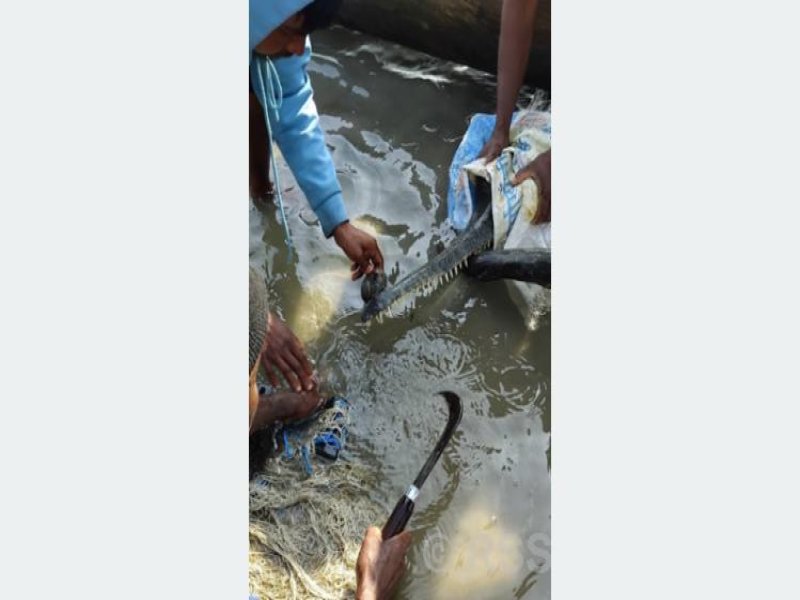
A critically endangered gharial crocodile was successfully rescued from the Narayani River after its mouth became entangled in a fishing net, highlighting both the threats facing aquatic wildlife and the importance of community-led conservation efforts. The adult male rocodile was freed following four days of continuous and coordinated rescue operations carried out by Chitwan National Park authorities with crucial support from the local Bote community, traditionally known as river-based boatpeople.
The incident occurred in the Amaltari area of Kawasoti Municipality in Nawalparasi (Bardaghat–Susta East), a region where crocodiles are known to inhabit river systems connected to Chitwan National Park. Officials confirmed that the reptile had been struggling to feed and survive due to the net tightly wrapped around its jaws, posing a serious risk to its life.

Joint Effort by Park Authorities and Local Community
According to Chitwan National Park Officer and Information Officer Abinash Thapa Magar, the rescue operation required patience, coordination, and expertise due to the animal’s size and vulnerable condition. Park staff, in collaboration with residents, worked tirelessly over four consecutive days to safely remove the fishing net without causing injury to the gharial.
“The rescue was challenging because the gharial was highly stressed and remained partially submerged in strong river currents,” Magar said. “Any sudden movement could have caused further harm to the animal.”
Resident Gopal Bote played a leading role in the rescue operation. Drawing on his deep knowledge of river behavior and aquatic wildlife, Bote coordinated closely with park officials and fellow community members to approach and restrain the gharial safely. The involvement of the Bote community proved vital, as their traditional expertise in navigating rivers helped ensure the success of the operation.
Safe Release and Rising Rescue Numbers
After the fishing net was carefully removed, the gharial was assessed for injuries and monitored by park officials before being released back into the Narayani River. Authorities confirmed that the animal was in stable condition and capable of swimming and feeding normally.
With this successful rescue, the number of gharials rescued from the Narayani River this year has reached four, underscoring the growing risks posed by discarded or improperly used fishing gear in river ecosystems.
Conservationists have repeatedly warned that fishing nets, plastic waste, and river pollution remain major threats to gharials, which rely on clean, undisturbed river habitats for survival.
Gharial Population Status and Conservation Concerns
Magar further shared data from a gharial census conducted last month, which revealed concerning population trends. The census recorded only nine male gharials in total, two in the Narayani River and seven in the Rapti River. Experts consider male gharials particularly crucial for maintaining breeding populations, and their low numbers pose a serious risk to the long-term survival of the species.
Overall, the Narayani River is currently home to 135 gharials, while the Rapti River hosts a comparatively larger population of 231 gharials. Despite these numbers, conservationists stress that the species remains critically endangered due to habitat degradation, accidental entanglement in fishing equipment, and reduced breeding success.
Breeding and Release Efforts Underway
To support the conservation of gharials, the Crocodile Breeding Centre in Kasara has been breeding the species in captivity for several decades. Once gharials reach adulthood and are deemed capable of surviving in the wild, they are released into major rivers such as the Narayani and Rapti.
“These rescue efforts complement our long-term conservation strategy,” Magar explained. “Breeding and release programs alone are not enough unless river habitats are protected and human-wildlife conflict is minimized.”

Community-Based Conservation Key to Survival
The successful rescue once again highlights the importance of community participation in wildlife conservation. Officials emphasized that cooperation between park authorities and local river-dependent communities is essential to protecting endangered species like the gharial.
Chitwan National Park has urged fishermen and residents to use river resources responsibly, avoid leaving nets unattended, and immediately report wildlife entanglements. Conservationists believe that awareness, combined with timely rescue operations, can significantly reduce preventable wildlife deaths.
As Nepal continues its efforts to conserve endangered species, the rescue of this gharial stands as a reminder that safeguarding biodiversity requires collective responsibility from authorities, conservationists, and local communities alike.