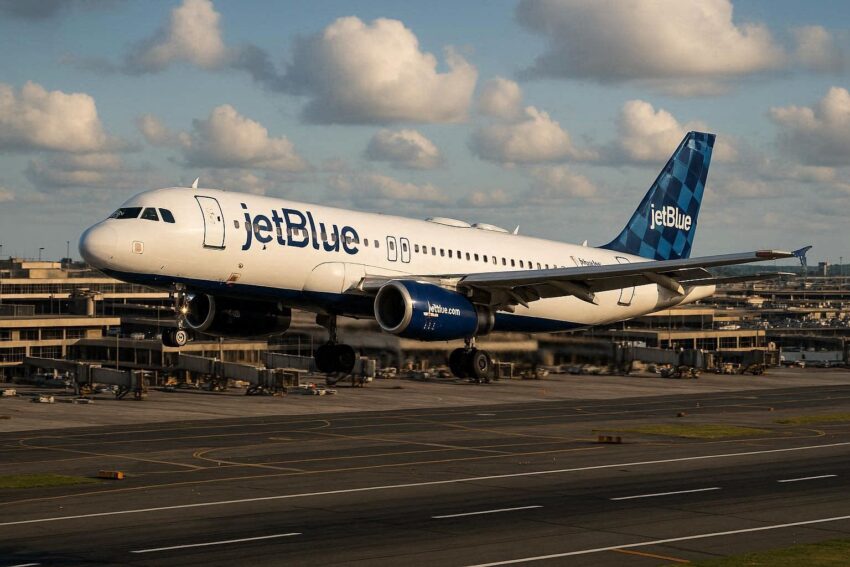
A routine domestic journey quickly escalated into an emergency on February 18, 2026, when a JetBlue Airways Airbus A320-200 flight bound for West Palm Beach, Florida, returned to Newark Liberty International Airport (EWR) shortly after takeoff. The aircraft, carrying 122 passengers and crew, remained airborne for just over 15 minutes before declaring an emergency due to reports of smoke in the cabin and a technical irregularity with the number one engine.
Airport rescue teams, federal authorities, and air traffic controllers coordinated immediately to ensure the safe handling of the situation. Upon landing at approximately 5:50 PM local time, a precautionary evacuation was conducted, temporarily halting operations on Newark’s taxiways and affecting both departures and arrivals across the evening schedule.

Emergency Declared Minutes After Takeoff
The JetBlue Airbus A320-200 departed Newark at 5:34 PM local time. Shortly into the climb, the cockpit crew reported an engine anomaly and detected smoke in the cabin’s rear section. Following standard aviation safety protocols, the flight was turned back to Newark.
The JetBlue aircraft executed a controlled landing and was guided to a designated taxiway, where emergency crews were on standby. Passengers were evacuated using emergency slides, and all individuals were accounted for shortly thereafter. One passenger experienced chest pains and was transported to a local hospital; no other injuries were reported.
Operational Disruption at Newark
The emergency response led to a temporary ground stop at Newark, impacting both arriving and departing flights. The Federal Aviation Administration coordinated traffic to accommodate emergency services while ensuring safety remained the top priority. Normal operations resumed by 7:00 PM, but delays cascaded through the airport’s tightly scheduled evening operations. Flight monitoring data showed nearly 400 delays across the day, making it one of the most delayed airports in the United States on that date.
The compact layout of Newark, with two parallel primary runways and an intersecting runway, magnified the operational impact, as any emergency requiring slide deployment or taxiway closure can significantly affect aircraft sequencing and gate availability.
JetBlue Aircraft Profile
The JetBlue aircraft involved, registered N640JB and named Blue Better Believe It, entered service in July 2006. Powered by two IAE V2500 engines, the jet has accumulated over 73,000 flight hours and approximately 26,000 cycles. Its cabin configuration includes standard economy and “Even More Space” seating for up to 162 passengers.
JetBlue operates a fleet of 289 aircraft, with the A320-200 representing a key component of its narrowbody operations. Despite the JetBlue aircraft’s 20-year service life, it falls within normal operational limits under rigorous maintenance programs regulated by U.S. aviation authorities.
Broader Implications for Air Travel
The incident highlighted how even a brief technical issue at a major hub like Newark can ripple across regional and national air travel. Newark serves as a critical node linking domestic destinations, including Florida, with international markets such as Canada and parts of Europe. The temporary ground stop disrupted evening schedules, leading to downstream delays, gate congestion, and adjusted flight operations at other airports.
Federal Investigation Underway
Federal authorities have launched an investigation into the engine irregularity and smoke reports. Technical inspections, crew reports, and maintenance records will be reviewed to determine the root cause. Incidents involving potential engine failure are subject to strict scrutiny, with corrective actions implemented as needed to maintain safety standards.

Aviation Safety Prioritized
Despite operational disruptions, the event concluded without serious injury. The coordinated response between flight crew and ground emergency teams underscores the U.S. aviation industry’s emphasis on precautionary measures and layered safety protocols.
JetBlue confirmed that passenger safety remains its highest priority and emphasized cooperation with authorities to investigate the incident thoroughly. The event serves as a reminder of the vigilance required in modern air travel and the robust systems in place to protect passengers, crew, and airport personnel.