Bhutan, however, has chosen a distinctly different way to introduce its vision for a new economic city to the world. Instead of beginning with investors and industrialists, the Himalayan kingdom brought together more than 40,000 volunteers at a single location, where they worked for around 12 hours to construct the outer structures of 108 giant Buddhist stupas. When a country builds a new industrial or economic city, the process usually begins with investment summits, invitations to business leaders, infrastructure groundbreakings, and campaigns highlighting economic opportunities.
The extraordinary event drew nearly 200,000 people, including residents from across Bhutan and visitors from different countries. Buddhist spiritual leaders, members of the royal family, ordinary citizens and international guests participated in or witnessed the event, transforming what could have been a religious ceremony into a major national and international spectacle. Held on November 1, 2026, the event was also designed to showcase the identity, philosophy and long-term economic vision of Bhutan’s ambitious Gelephu Mindfulness City project.
Project 108 Combines Religion, Community and Urban Development
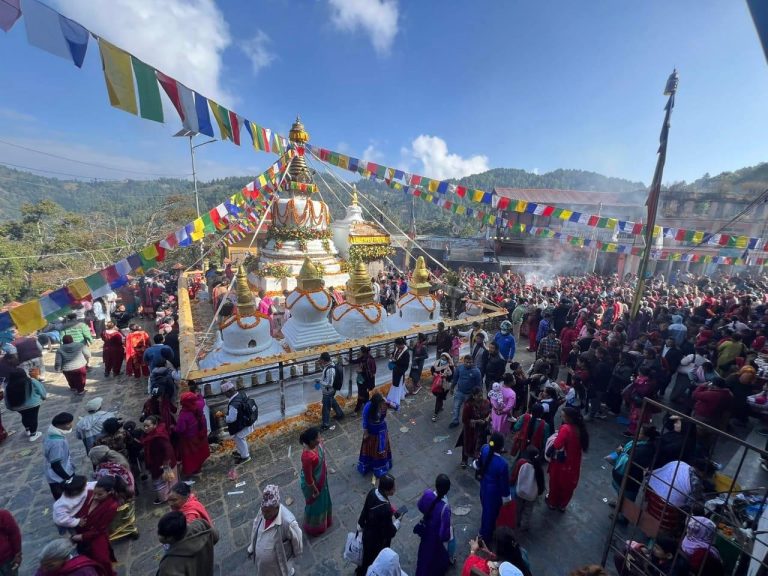
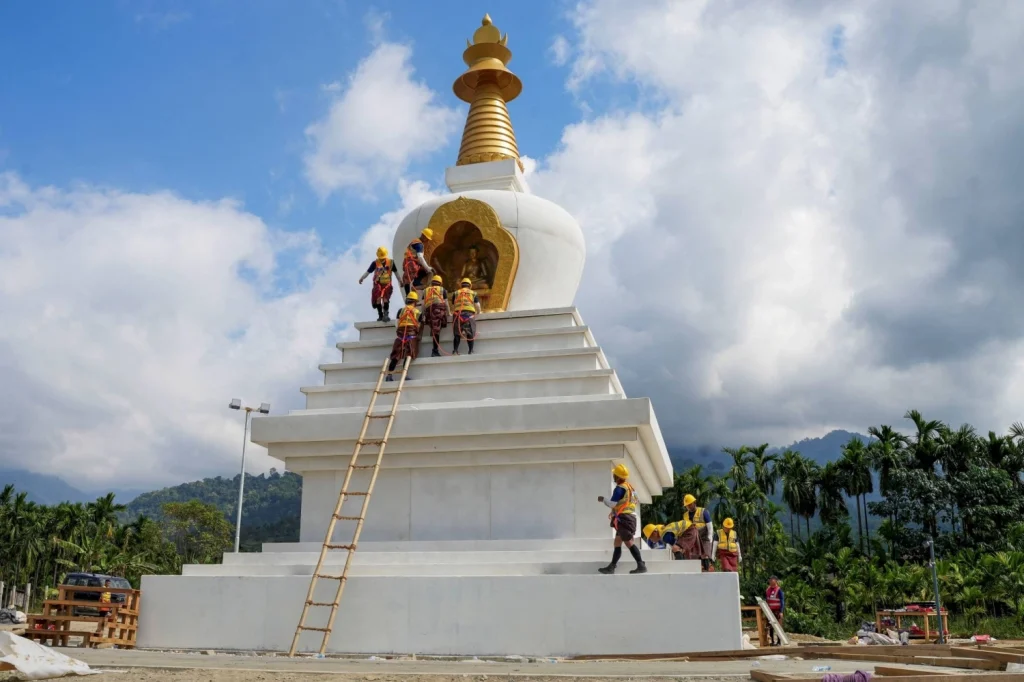
The initiative, known as Project 108, began on November 1 and continued for four days until November 4. Its main attraction was the simultaneous construction of 108 Buddhist stupas on the first day. Each stupa is approximately 15 metres, or 50 feet, high, with the structures spread along an approximately 11.7-kilometre stretch beside the Mao Chhu River. The stupas have been positioned around 108 metres apart from one another, creating a vast chain of religious structures across the landscape.
The construction began at around 3 a.m., with volunteers working simultaneously at 108 different locations. Within approximately 12 hours, the outer structures of all 108 stupas had been completed, making the exercise an extraordinary example of large-scale coordination, community participation and collective labour.
According to Bhutan Broadcasting Service reports, the event began early in the morning in the presence of members of the royal family, senior Buddhist spiritual leaders and thousands of volunteers. The construction process was accompanied by Buddhist prayers, traditional instruments and religious rituals, blending spiritual practice with a highly coordinated community effort.
Why the Number 108 Matters
The number 108 carries deep religious significance in Buddhist traditions and is associated with spiritual practice, meditation and the pursuit of enlightenment. As a result, the 108 stupas are intended to serve a purpose beyond simply becoming architectural or decorative landmarks.
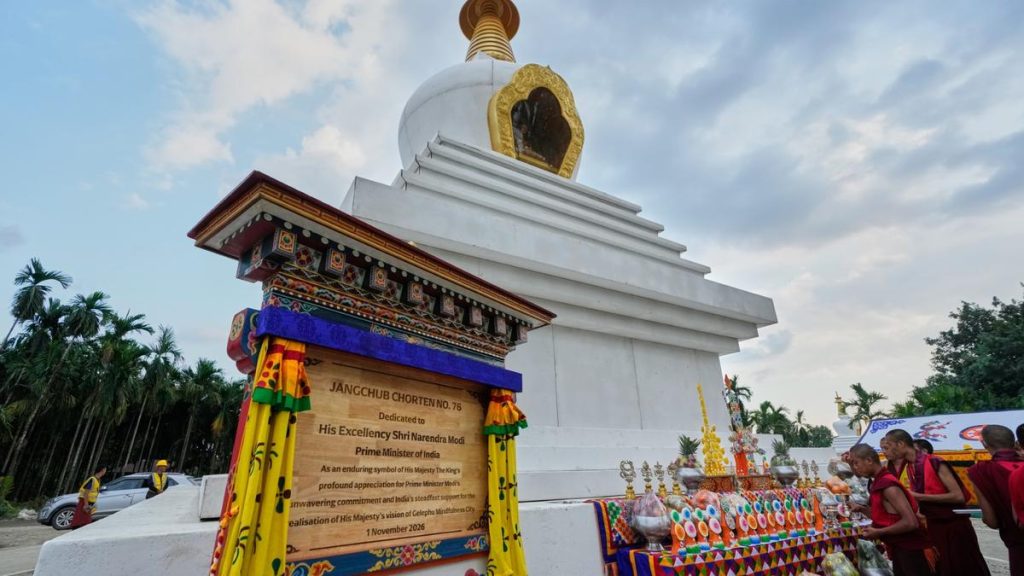
The stupas are planned to contain prayers, blessings, sacred scriptures and other religious materials before being sealed. Their religious consecration and related rituals are also part of the wider programme. Through Project 108, Bhutan has effectively transformed religious faith and collective volunteerism into a national initiative, using spiritual heritage as an important part of the identity of a city that is being envisioned as a future international economic centre.
Why Place Buddhist Stupas at the Heart of an Economic City?
The project reflects the long-term development vision of King Jigme Khesar Namgyel Wangchuck, who announced plans to develop Gelephu as a new economic hub during Bhutan’s National Day celebrations on December 17, 2023. The King’s vision differs significantly from the conventional model of developing an industrial or financial city. Rather than treating economic growth, spirituality, environmental protection and human well-being as competing priorities, the concept seeks to integrate them into a single development model.
The city’s name itself, Gelephu Mindfulness City, reflects this philosophy. Mindfulness generally refers to being conscious of the present moment, understanding one’s thoughts and behaviour, and maintaining balance with society and nature. The concept has a deep connection with Buddhist philosophy, and Bhutan is attempting to translate this principle into an urban development framework.
Under this vision, the success of the city will not be measured solely by the number of industries established, buildings constructed or investments attracted. Questions concerning the quality of life of residents, environmental sustainability and preservation of local culture are also intended to form an integral part of the development model. The official Gelephu Mindfulness City concept describes the project as an international economic hub inspired by Bhutan’s Buddhist spiritual heritage, designed around environmental sustainability and mindful business practices.
Gelephu: From a Small Southern Town to a Future Economic Hub
Gelephu is located in southern Bhutan, close to India’s Assam state. The designated area covers approximately 4,046 square kilometres, equivalent to around 10 percent of Bhutan’s total land area. The existing town has a population of roughly 10,000 people and lies approximately 240 kilometres from Bhutan’s capital, Thimphu. Bhutan now intends to transform this relatively small settlement into a future international economic centre.
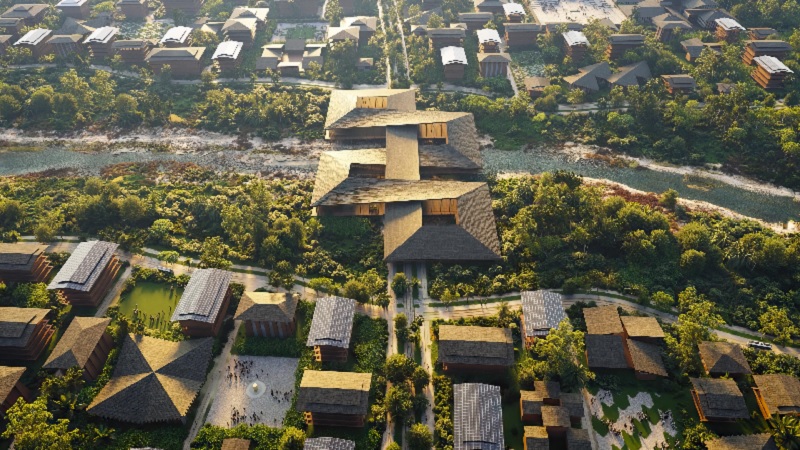
The Gelephu Mindfulness City was formally established as a Special Administrative Region (SAR) through a Royal Charter in February 2024. This special status is intended to allow the city to operate under a distinct administrative, legal and economic framework. The city’s master planning and architectural vision has involved internationally recognised firms, including Denmark-based Bjarke Ingels Group (BIG), along with Arup and other organisations.
Designing a City Around Rivers, Forests and Wildlife
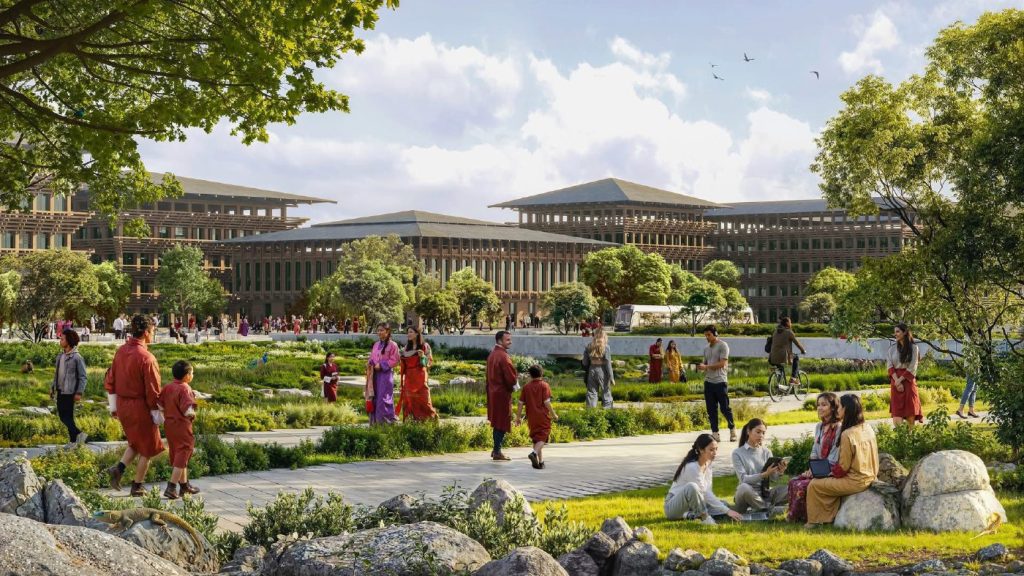
One of the defining features of the Gelephu project is its approach to nature. Rather than treating rivers and forests as obstacles to urban development, the plan seeks to incorporate them into the structure of the city. The development framework takes into account the natural flow of 35 rivers and streams. Agricultural land, including rice fields, and open spaces along waterways are planned to remain in place, allowing water to spread naturally during the monsoon and helping reduce flood risks.
Bridges connecting different parts of the city are also envisioned as more than transportation infrastructure. They are expected to connect communities with universities, healthcare facilities, cultural institutions, markets and spiritual centres. Wildlife conservation is another important element of the design. The city is being planned in a way intended to minimise disruption to the natural movement of elephants and other wildlife. In this sense, Bhutan’s approach is not simply about removing nature to make space for buildings. Instead, the ambition is to develop an urban environment within the natural landscape, allowing forests, rivers, agricultural areas and wildlife corridors to remain integral to the city’s identity.
Eight Economic Sectors from Spirituality to Artificial Intelligence
Another distinctive feature of the Gelephu project is its ambition to diversify Bhutan’s economy beyond its traditional dependence on tourism and hydropower. According to the project’s official development framework, eight priority sectors have been identified as the foundation for the city’s future economic development. These include spirituality, modern healthcare and wellness, universities and international education, agricultural technology and forestry, hydropower and clean energy, finance and digital assets, aviation and international trade, and tourism, nature and culture. The objective is to connect these sectors and develop high-value services and businesses within an integrated economic ecosystem. One of the most striking elements of the model is the planned coexistence of spirituality and financial services within the same economic centre.
A Different Model of an International Financial Centre
When international financial centres are discussed, cities such as Singapore, Dubai, Hong Kong and Zurich are commonly cited. These destinations have built their economic identities around banking, capital markets, investment and international trade. Bhutan is attempting to create an economic centre with some comparable international ambitions, but with a fundamentally different identity. Instead of separating economic activity from cultural and spiritual heritage, Gelephu aims to place Bhutan’s Buddhist philosophy and environmental values at the heart of its economic model.
The city seeks to bring together meditation, yoga, wellness services, environmentally sustainable technologies, agricultural research and digital finance within a single economic ecosystem. This combination could give Gelephu a distinctive position in the global market, particularly as demand grows for wellness tourism, sustainable investment, digital finance and environmentally responsible development.
Special Administrative Status to Support International Business
The administrative structure planned for Gelephu is another unusual feature of the project. Bhutan does not intend to develop the city simply as a conventional municipality or industrial zone. Instead, its Special Administrative Region status is intended to provide a different legal and economic framework from the rest of the country. The concept has been described in terms of a “One Country, Two Systems” approach, under which Gelephu would receive its own executive and legislative authority along with an independent judicial structure within the broader framework of Bhutan.
The proposed framework is particularly focused on creating an environment suitable for international investors and businesses. Areas such as foreign investment, company registration, banking and financial services, commercial dispute resolution and digital-asset-related activities are expected to follow internationally oriented standards.
A New Economic Identity Built on Bhutanese Values
The 108-stupa initiative therefore represents more than a large religious gathering. It provides a symbolic introduction to the philosophy behind Gelephu Mindfulness City: an attempt to combine economic ambition with spirituality, technology with nature, and international investment with Bhutanese cultural identity. By bringing together tens of thousands of volunteers and hundreds of thousands of spectators, Bhutan has used one of its strongest cultural and spiritual traditions to communicate its vision for the future.
For Gelephu, the challenge now will be to translate that vision into a functioning economic ecosystem capable of attracting international investment, creating jobs, supporting innovation and maintaining environmental and cultural integrity. If successful, the project could offer an alternative model of economic urbanisation, one in which a city’s competitiveness is measured not only by investment and infrastructure, but also by well-being, sustainability, spirituality and its relationship with nature.