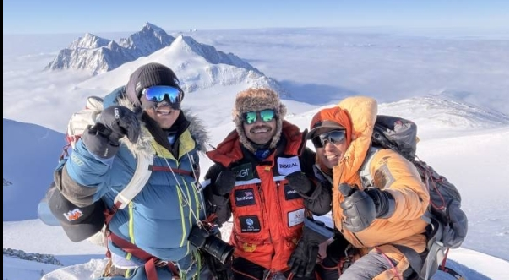
IFMGA-certified Nepali mountain guide Abiral Rai has created history by becoming the first climber from the Kirat Rai (Thulung Rai) community to successfully summit Mount Vinson, the highest peak in Antarctica at 4,892 meters. Rai reached the summit at 10:00 pm on January 6, marking a milestone of both national and cultural significance for Nepal’s indigenous mountaineering community.
His achievement adds a new chapter to Nepal’s presence in the polar region and highlights the growing role of Nepali climbers in global high-altitude expeditions beyond the Himalayas.

A Remote and Demanding Achievement
Mount Vinson is considered one of the most logistically challenging peaks in the world due to its extreme weather, isolation, and high operational costs. Globally, only about 1,200 climbers have ever reached its summit. Nepali climbers on Vinson remain relatively few, making Rai’s ascent particularly notable in Nepal’s international mountaineering narrative.
The expedition was led by veteran mountaineer Jangbu Sherpa, who completed his 18th ascent of Vinson, accompanied by Mingma Sherpa and Hari Budha Magar. The climb was especially historic as Hari Budha Magar became the world’s first double above-knee amputee to complete the Seven Summits, a landmark achievement in global mountaineering.
According to the Nepal National Mountain Guide Association (NNMGA), a total of seven Nepali climbers reached the summit on the same day, making the expedition a landmark moment for Nepal in Antarctica.
Four Continental Summits Completed
For Abiral Rai, the Vinson summit marks the fourth continent conquered in his Seven Summits journey, the challenge of climbing the highest peaks on all seven continents. In 2025, Rai had already made history as the first member of the Rai community to summit Aconcagua (6,960 meters) in South America and Carstensz Pyramid (4,884 meters) in Oceania.
Combined with his Asian high-altitude ascents, Rai has now completed four of the world’s seven continental summits. These accomplishments place him among a small group of Nepali climbers steadily building a global legacy beyond the Himalayas. His steady progress places him among Nepal’s rising elite mountaineers who are gaining global recognition through technical excellence, endurance, and leadership in international expeditions.
From Porter to Elite International Guide
Rai’s personal journey is a powerful story of perseverance and professional growth. Beginning his mountaineering career as a porter, he went on to earn IFMGA/UIAGM certification in 2019, one of the highest and most respected qualifications in the international mountain guiding profession.
Since then, Rai has guided hundreds of climbers on major Himalayan peaks, including Mount Everest, Lhotse, and Manaslu, as well as on international expeditions across continents. His progression from a support staff role to an internationally certified guide reflects years of discipline, technical mastery, and leadership development.
A Source of Pride for the Rai Community and Nepal
Following the ascent, Rai described the achievement as “an unforgettable and historic day for Nepal in Antarctica,” expressing pride for both his community and the nation. “It was a proud moment for the Rai community and Nepal,” he wrote in a social media post, extending gratitude to his teammates, supporters, and well-wishers.

Inspiring a New Generation
As Abiral Rai continues his pursuit of the remaining three continental summits, his achievements are increasingly inspiring young Nepalis entering the mountaineering profession. By carrying the identity of the Kirat Rai community to the world’s most remote peaks, he has added a distinct chapter to Nepal’s climbing legacy, one defined by representation, perseverance, and cultural pride.
With Mount Vinson now behind him, Abiral Rai stands as a rising symbol of Nepal’s expanding global mountaineering presence and a powerful example of how dedication and opportunity can transform lives and communities, and it is a symbol of representation, resilience, and cultural pride, reaffirming Nepal’s enduring leadership in the global mountaineering world.