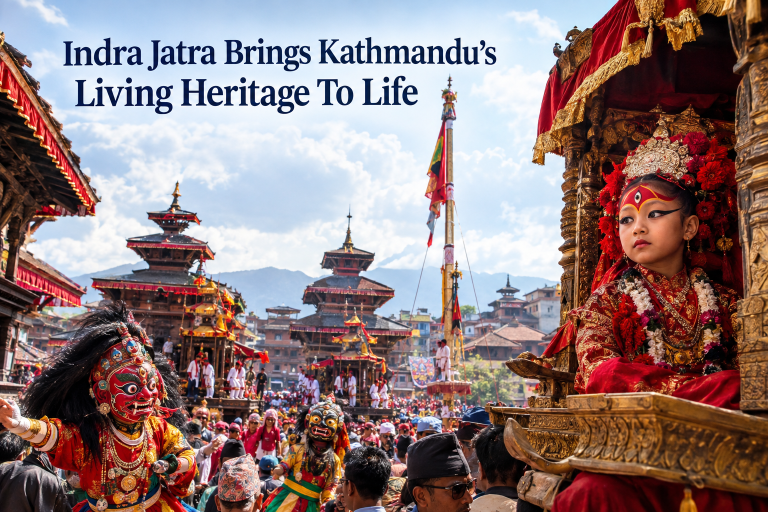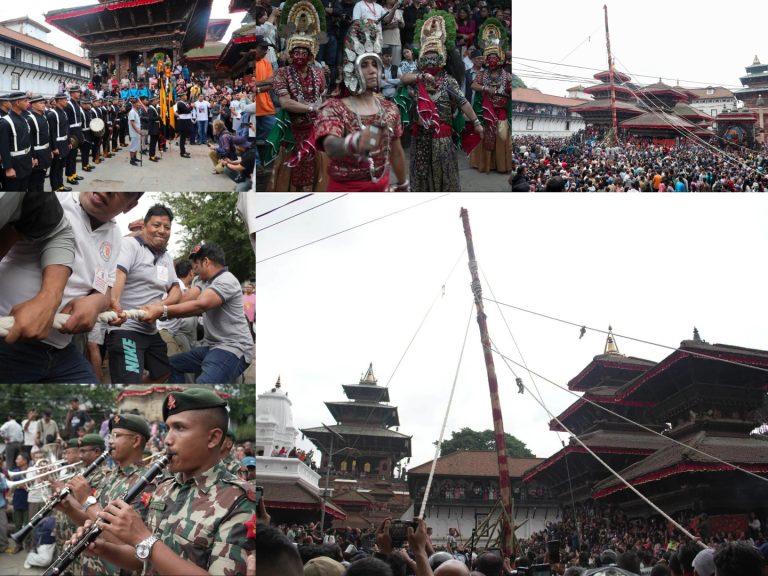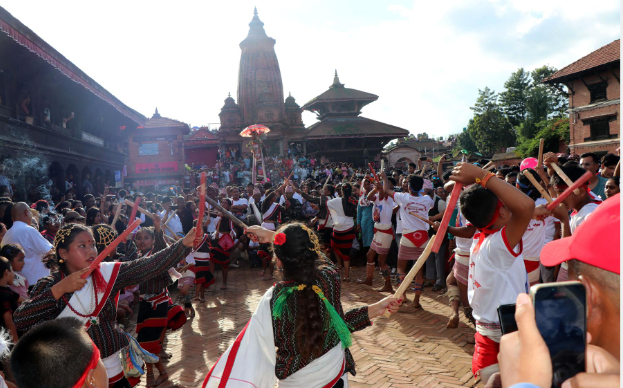
The traditional Gai Jatra festival, one of the most colorful and culturally rich events in the Newar community, was celebrated with great enthusiasm in Bhaktapur this year. The highlight of the festival was the procession of the Bhailadya Tahamacha, a symbolic representation of the deity Bhairab made from straw, accompanied by the lively Ghintang Ghisi dance, which marks the conclusion of the main Gai Jatra festivities.
This year, the festival saw a grand display with 29 Tahamachas, including one Bhailadya Tahamacha, paraded around the courtyard of the Nyatapola Temple and the Durbar Square area. According to Narendra Prasad Joshi, the main priest of Taleju, the procession was conducted in a circular formation, symbolizing the completion of the Gai Jatra festival.
The festival celebrated on the first day of the lunar fortnight of Bhadra (Bhadra Shukla Pratipada), is dedicated to honoring those who have passed away in the past year. Family members and relatives of the deceased commemorate their loved ones through cultural processions, humorous performances, and symbolic displays.
The Ghintang Ghisi dance, a key attraction of Bhaktapur’s Gai Jatra, involves participants rhythmically striking wooden sticks while dancing in groups. This dance, performed to the beats of traditional instruments like Dhime, Bhusya, and Khin, symbolizes the collective strength of the community and the removal of obstacles from the deceased’s path to the afterlife. This year, the dance saw significant participation from the youth, adding vibrancy to the festivities.
The Tahamacha, a structure made from four green bamboo poles covered in cloth, with a cow’s head depicted at the top, symbolizes the cow that guides the souls of the deceased to heaven. The Tahamacha is decorated with straw horns, peacock feathers, colorful flowers, and a representation of the eight mother goddesses, Astamatrika, at the center. Images of gods and the deceased, along with mirrors, are placed on the front and back of the Tahamacha, which is then carried in a procession throughout the city.
Potters in Bhaktapur also play a significant role in the Gai Jatra celebrations. As part of their ancestral profession, they create clay cows, which are paraded around the city to honor the deceased and ensure their peaceful passage to the afterlife. Cultural expert Dr. Purushottam Lochan Shrestha explains that this tradition reflects the deep connection between the potters’ craft and the rituals of Gai Jatra.
The festival also features musical and theatrical performances, including renditions of the Ramayana and Krishna Leela, which are performed with a focus on the theme of compassion. Children are dressed as deities such as Shiva-Parvati and Krishna-Radha and are paraded through the streets, adding to the festival’s charm.
Before the Gai Jatra procession, a series of rituals, including offerings and shraddha ceremonies, are performed to honor the deceased. Family members, especially women, are traditionally expected to mourn during these rituals, which are considered a sign of respect for the departed.
The Gai Jatra procession is marked by various symbolic gestures. For instance, if the deceased is a child, the procession includes a Doko (a traditional bamboo basket) instead of a Tahamacha. If the deceased is a woman, the Tahamacha is draped in red or blue cloth with a sari, while for a man, it is covered in white. In the case of a pregnant woman, a smaller cow figure is included in the procession. If two family members have passed away, an additional set of horns is added to the Tahamacha, representing both deceased individuals.
The people of Bhaktapur believe that the Gai Jatra festival opens the gates of heaven, allowing the souls of the deceased to grasp the cow’s tail and cross the mythical river Vaitarani, reaching the heavenly abode. The Bhairab Tahamacha is paraded around the city, circling key locations such as Taumadhi, Durbar Square, and Tachapal three times before being dismantled at the Chupinghat bridge and the straw floated down the Hanumante River.
In Bhaktapur, the Gai Jatra festival continues until Krishna Ashtami, with various cultural performances and processions providing entertainment to the public. During this period, processions of deities like Dattatreya, Bhairab, Bhimsen, Barahi, and Krishna are held, with performances of traditional dances such as Maku Pyakhan, Nagacha Pyakhan, Lakhe Pyakhan, Devi Pyakhan, Bhail Pyakhan, Bhalucha Pyakhan, Ramayana, Lucicha Pyakhan, and Khicha Pyakhan adding to the festivities.
Cultural expert Dr. Shrestha notes that the tradition of celebrating Gai Jatra with musical processions dates back to the reigns of King Pratap Malla in Kathmandu, King Jagat Prakash Malla in Bhaktapur, and King Siddhinarsingh Malla in Lalitpur. This rich heritage continues to be an integral part of the cultural fabric of the Kathmandu Valley, particularly in Bhaktapur, where Gai Jatra remains one of the most cherished and visually captivating festivals.