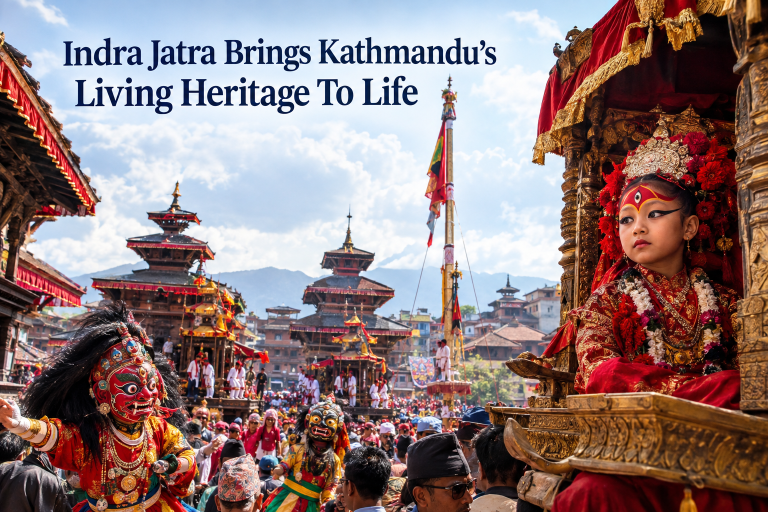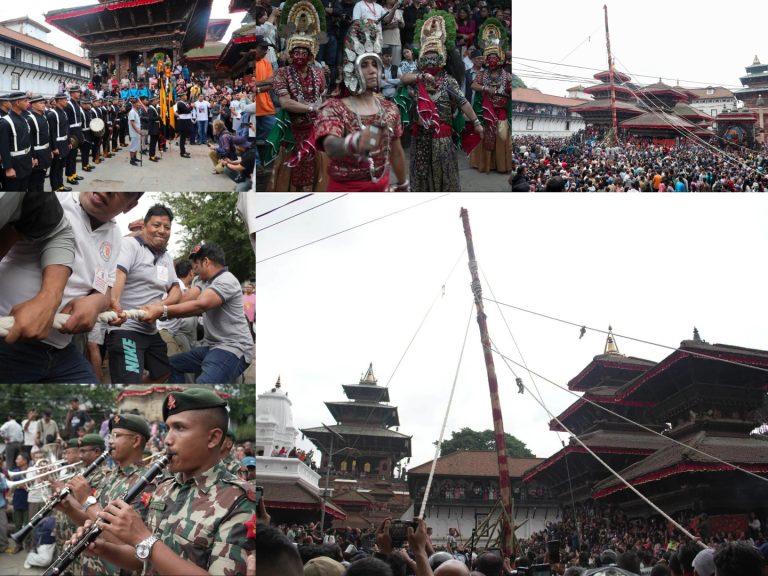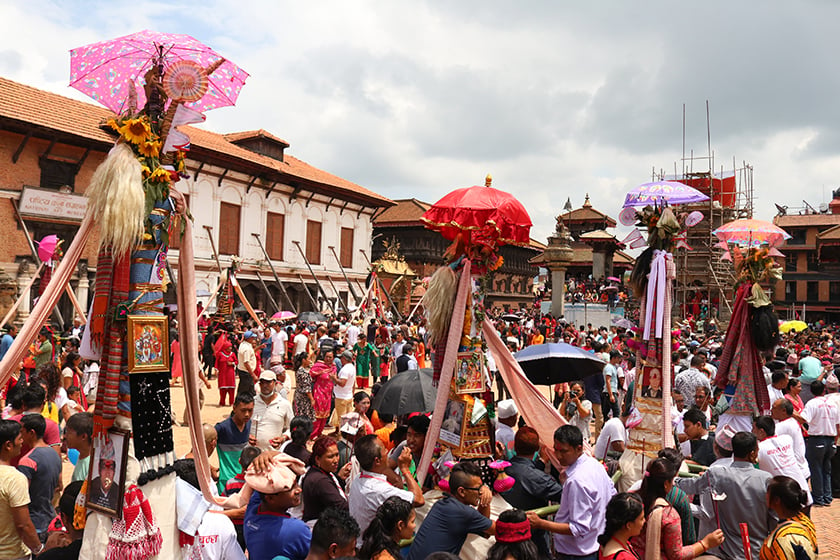
The Gai Jatra festival, a vibrant celebration observed for eight nights and nine days, commenced today in Bhaktapur. The festival began on Monday evening with a traditional ‘Ghintang Ghisi’ dance, organized by the Guthi office, which paraded through Bhaktapur after starting from the Bhairav Temple at Taumadhi Square.
Narendra Prasad Joshi, the chief priest of the Taleju Temple, informed that the festival officially began with the worship of Taleju and the ceremonial procession of the cow from the temple in the evening. The Newar community across Bhaktapur celebrated the festival from the early morning by leading processions of decorated cows through various neighborhoods, accompanied by the rhythmic beats of the ‘Ghintang Ghisi’ dance.
Cultural expert Binda Joshi explained that the Gai Jatra procession is a tradition held in memory of deceased family members. On this day, participants wear nine pairs of clothes, eat nine different types of food, and circle their neighborhood nine times. The day also involves rituals where participants offer milk, fruits, bread, beaten rice, yogurt, grains, and money to those participating in the procession.
The famous ‘Ghintang Ghisi’ dance, which involves singing cultural songs and is performed across Bhaktapur, remains the main attraction of the festival. In recent years, the dance has also drawn significant participation from foreign tourists, who join in with sticks in hand, adding to the festival’s appeal. The local youth clubs have played a crucial role in promoting this dance to enhance tourism.
Alongside the ‘Ghintang Ghisi’ dance, other traditional dances like the Hanuman Dance, Jungle Dance, and the Monkey Dance (Mak Pyakhan) are performed in various neighborhoods. Additionally, dances dedicated to deities such as the Lakhe Dance and Bhairav Dance are also showcased.
Even those with limited means participate by dressing up children as deities or by leading a live cow in the procession. The various processions from different households circle prominent landmarks such as Durbar Square, Balakhu Ganesh, Choche, Bholache, Mahalaxmi, Nagpokhari, Kwatandou, Navadurga Sthan, Suryamadi, Dattatreya, Sukuldhoka, Golmadi, Taumadhi, Pottery Square, Vansagopal, Itache, and Khauma.
The festival concludes with a final procession from Taumadhi in the evening, featuring effigies made of straw and the Bhairav Dance. The effigies, including those of Bhairav and Ajima, are paraded from the Bhairav Temple in Taumadhi, with the main effigy of Nakinjya Ajima leading the procession through various locations before circling Durbar Square three times, marking the end of the day’s festivities.
A traditional belief holds that no other effigies should be paraded after the effigies of Bhairav and Ajima have been displayed. The festival also features satirical and comedic performances, with participants carrying cartoons and satirical placards through the streets. Over the course of the week-long festival, the ‘Ghintang Ghisi’ dance, Hanuman Dance, Mak Pyakhan, Jungle Dance, and other cultural performances are showcased in various neighborhoods.
On Krishna Janmashtami, hundreds of women in traditional Newari attire, known as Hakupatasi, light lamps and parade through the streets, continuing a longstanding tradition. On this day, after worshipping Narayan, the children and youth of Bhaktapur light oil lamps on their heads, hands, and bodies and parade from Suryamadi to Dattatreya, Sukuldhoka, Taumadhi, Vansagopal, and Inacho Durbar Square, before returning to Suryamadi.
According to Hindu scriptures like the Padma Purana, the gates of Yamalok (the realm of the dead) remain closed throughout the year, opening only when the Gai Jatra procession is held on Earth, allowing the departed souls to enter Yamalok and attain liberation. Cultural practitioner Ram Shekhar Shrestha emphasized that leading a cow around the city is believed to help the deceased cross the Vaitarani River by holding onto the cow’s tail.
The historical origins of Gai Jatra date back to King Pratap Malla, who initiated the festival to console his grieving queen after the death of their son. To show her that others also suffered similar losses, he ordered his subjects to lead a cow procession through the city in memory of their deceased loved ones. When the queen’s sorrow remained unalleviated, the king further decreed the inclusion of satirical and comedic performances, a tradition that continues to this day.